
Stone Moods — Specification Guide
The Natural Stone Shower Guide: Walls, Floors, Niches & What Goes Behind the Stone
✓ Zone-by-zone stone choices ✓ Slip & slope basics ✓ Waterproofing reality ✓ Sealing & cleaning rules
Most shower failures are not stone failures. The stone is usually fine; what fails is everything around it: a missing waterproofing layer, a floor that doesn’t drain, a sealer that was never reapplied, or a cleaner that quietly etched the surface. A natural stone shower can easily last decades, but only if it is specified as a system, not as a pretty material.
If you are still choosing which stone to use in the bathroom overall, start with our Best Stone for Bathroom guide. This page assumes you are building a shower and want to get the details right.
The honest answer:
Natural stone is not waterproof, and no sealer makes it waterproof. A shower stays dry behind the stone because of a waterproofing membrane and a sloped floor, not because of the stone. Choose a harder, denser stone for the floor, where water, soap, and foot traffic concentrate. Use the more expressive, softer stones on the walls and in niches, where they only see splashing. Seal before grouting, use pH-neutral cleaners only, and never specify a polished floor.
Quick Reference: Stone by Shower Zone
| Zone | Main risk | Best-suited choices | Finish to ask for |
|---|---|---|---|
| Shower floor | Slipping, standing water, grout wear | Granite, slate, basalt, dense limestone, or mosaics of marble/travertine | Honed, leathered, flamed, or tumbled (never polished) |
| Walls (wet zone) | Staining, etching from products | Marble, travertine, limestone, quartzite, granite | Honed or polished, sealed |
| Niche & shelves | Standing water, product spills | Same stone as the wall, or a harder contrast stone | Honed; sloped bottom |
| Bench & curb | Standing water, heavy contact | Granite, quartzite, dense marble slab | Honed or leathered; slope toward drain |
| Steam shower | Constant moisture and heat | Dense, low-absorption stones | Honed; verify steam-rated membrane |
1. The Shower Floor: Where Stone Choice Matters Most
Priority: grip, drainage, and low absorption.
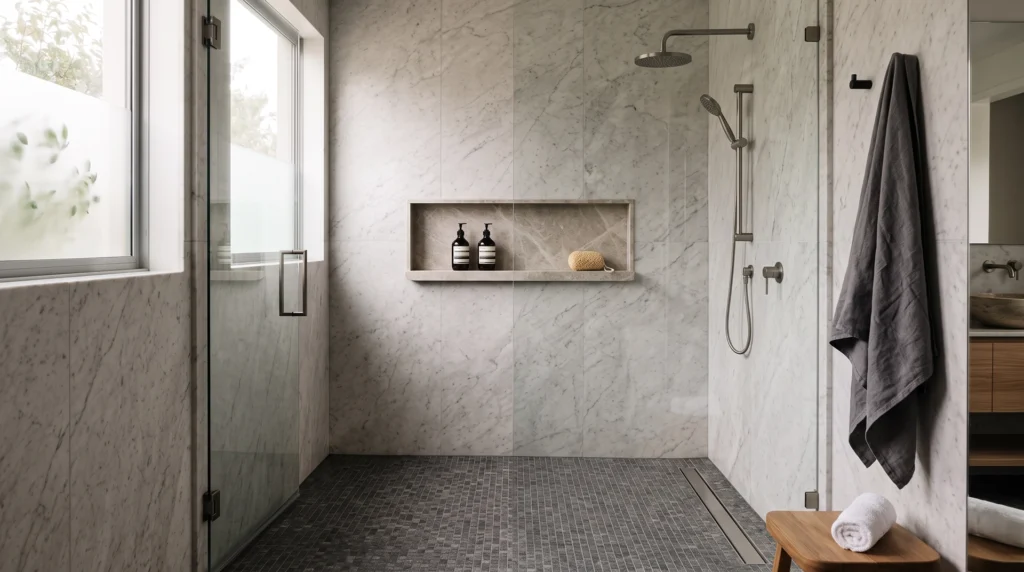
The floor takes water, soap film, and wet feet every day. Hard, dense stones such as granite (Mohs 6–7), basalt (~6), and quality slate are the safest long-term performers because they resist wear and absorb little water. Marble and travertine (both Mohs 3–4) can work on a shower floor, but as small-format mosaics rather than large tiles, where the many grout joints add traction and the small pieces follow the floor’s slope.
Finish matters as much as stone. A polished stone floor becomes slippery as soon as soap hits it. Ask for honed, leathered, flamed, or tumbled surfaces; our Honed vs. Tumbled Finish comparison and Leathered vs. Polished Finish comparison explain how each behaves when wet. Ask the supplier for the stone’s wet slip-resistance data; a dynamic coefficient of friction (DCOF) of 0.42 or higher is the commonly used benchmark for wet interior floors.
Slope is not optional. The floor must pitch toward the drain, typically about 1/4 inch per foot, with no flat spots where water can sit. Standing water is what turns a good stone floor into a stained, moldy one.
2. The Walls: Where You Can Be More Expressive
Priority: staining resistance and etching awareness.
Walls get splashed but not stood on, which is why this is the place for veined marble, travertine, or limestone, as long as you accept the maintenance. Marble, travertine, and limestone are calcium-based and react with acids, so a shampoo, bathroom cleaner, or even hard-water descaler can leave dull etch marks, especially on polished surfaces. Harder, quartz-rich stones such as granite and quartzite shrug this off.
Light-colored marbles and limestones can also show moisture from the back. Ask your tile setter about white, stain-free setting materials for pale stones; the wrong thinset can darken or discolor light stone from behind.
The waterproofing reality: Grout and stone are both porous to some degree, and water will move through them over time. A proper shower has a continuous waterproofing membrane (sheet or liquid-applied) behind the tile and under the floor, turned up the walls and sealed at the drain and corners. If your contractor says “the sealer will handle it,” that is the moment to find a different contractor.
3. Niches, Benches & Curbs: The Small Details That Fail First
Priority: slope and fewer joints.
Niches collect product spills and standing water, and the bottom of a niche should always slope slightly outward so water drains back into the shower. Use a single stone piece or as few grout lines as possible, and seal the cut edges, since the interior of a stone is often more porous than its factory-finished face. Benches and curbs need the same treatment: a slight slope toward the drain and a dense stone that tolerates direct contact and standing water.
4. Grout, Sealing & Cleaning: The Maintenance Triangle
Priority: seal first, clean gently, inspect yearly.
- Seal before grouting. A penetrating sealer applied before grout keeps pigment and moisture from migrating into the stone’s edges. Seal again after grouting cures, then reapply on a schedule suited to the stone (porous stones need it more often).
- Choose grout for the stone. Use unsanded grout in narrow joints on softer, polished stone to avoid scratching, and consider epoxy grout in the highest-moisture zones for stain resistance.
- Use only pH-neutral stone cleaners. Vinegar, lemon-based products, and standard bathroom sprays can etch calcium-based stone permanently.
- Squeegee and ventilate. Drying the surface after use and running an exhaust fan are the cheapest forms of stone protection there are.
5. Steam Showers: Stone Can Do It, With Conditions
Dense stone is a good fit for steam rooms because it holds heat well, but the system around it must be built for constant moisture: a steam-rated waterproofing membrane, a ceiling sloped so condensation runs down the walls rather than dripping, and low-absorption stone. Highly porous or moisture-sensitive stones are a poor match for steam.
Decision Framework: Four Questions Before You Order
- What is under the stone? Confirm the waterproofing system and slope before approving any slab or tile.
- What finish is on the floor? If it is polished, change it.
- Who will clean it? If acidic cleaners are likely, favor granite or quartzite for walls, or accept etching on marble.
- Will you seal it on schedule? If not, choose the densest stone you like, not the most porous one.
Planning a Stone Shower?
Check how a stone behaves in daily bathroom use and estimate the real installed cost before you order.
Maintenance Reality Score
True Cost Calculator
Find Your Stone
Frequently Asked Questions
Can you use marble in a shower?
Yes, and it is done often, but go in knowing it is softer (Mohs 3–4) and acid-sensitive. Use it on walls rather than the floor, choose a honed finish, seal it, and clean it with pH-neutral products only. For the floor, use marble mosaics or a harder stone.
Is travertine a good choice for a shower floor?
It can be, in a honed or tumbled finish with filled voids and tight sealing discipline. Its natural pores trap soap film and moisture, so it needs more regular care than granite or slate, which is why many designers use it on walls and choose a harder stone for the floor.
Does sealing make stone waterproof?
No. Sealers slow absorption and stain penetration, but they do not stop water. Waterproofing comes from a membrane behind and beneath the stone, combined with proper slope and drainage.
How often should a stone shower be resealed?
It depends on the stone and how heavily the shower is used. A simple test: sprinkle water on the surface; if it darkens within a few minutes instead of beading, it is time to reseal. Denser stones such as granite need it far less often than porous marble or travertine.
Is slate or granite better for a shower floor?
Both perform well. Granite is harder and less absorbent; slate has a naturally textured, riven surface that offers excellent grip but may be harder to clean. Choose by the look you want and the cleaning effort you accept.
Related Reading on Stone Moods
- Best Stone for Bathroom: The Complete Guide
- 10 Moody Bathroom Ideas: The Art of Darkness & Stone
- Honed vs. Tumbled Finish: Which Stone Surface Should You Specify?
- Slate vs. Basalt: Which Dark Stone Wins for Facades and Floors?
- Stone Finishes Glossary: Polished, Honed, Leathered & More