
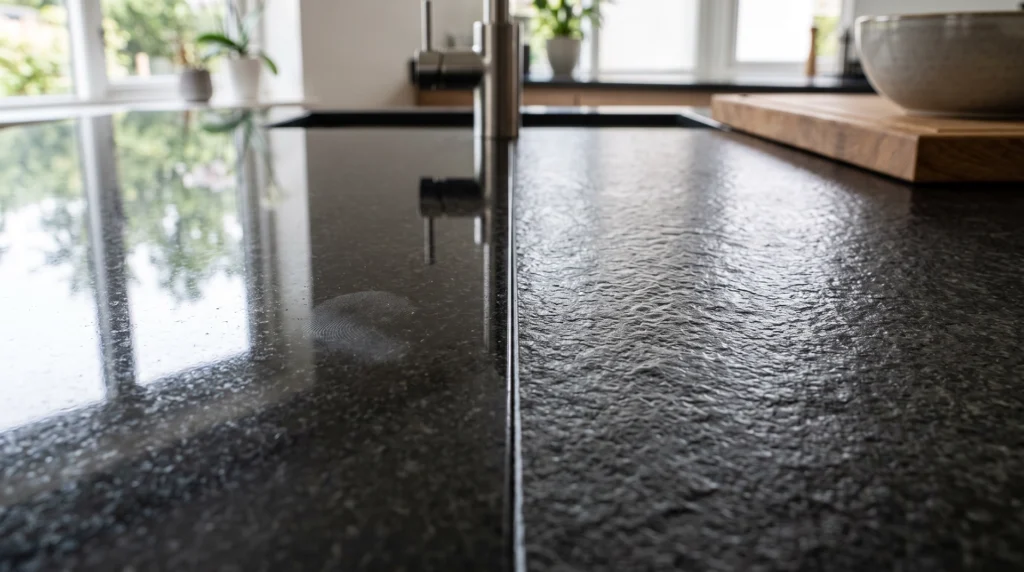
Leathered vs. Polished Finish: Which Stone Surface Should You Choose?
Polished stone is the finish everyone recognizes: mirror-bright, deeply colored, and unmistakably formal. Leathered stone is its quiet opposite: soft-sheen, textured, and built to look lived-in from day one. Both can be applied to the same slab of granite, quartzite, or even some marbles, which means the choice isn’t about the stone. It’s about how the surface should look, feel, and age under daily use.
This guide focuses on what each finish does to color depth, fingerprints, etching, slip resistance, and cost. If you’re also weighing a flat matte option, our Honed vs. Tumbled Finish comparison covers the other end of the finish spectrum.
Quick answer:
Polished finish is created by grinding the stone through progressively finer abrasives and buffing it to a high-gloss, reflective surface that maximizes color and veining depth. Leathered finish is created by brushing a polished or honed surface with diamond-tipped nylon brushes, which follow the stone’s natural mineral variation to leave a soft, undulating, low-sheen texture. Choose polished for formal, high-impact surfaces where color depth matters most and you accept more visible wear on soft stones. Choose leathered for kitchens and high-use areas where hiding fingerprints, water spots, and minor wear matters more than a mirror shine.
What Each Finish Actually Is
What Is a Polished Finish?
Polishing is the final stage of a multi-step grinding sequence. The surface is worked with progressively finer abrasives until the stone’s crystals are smoothed flat enough to reflect light like a mirror. That reflectivity is what makes polished stone look so saturated: it deepens color, sharpens veining, and makes the stone look wet, even when it is perfectly dry.
What Is a Leathered Finish?
Leathering is a texturing process applied on top of a smoother surface. Diamond-impregnated brushes scrub the stone, and because the brushes wear softer minerals slightly more than harder ones, the result is a subtly undulating surface with a gentle sheen and a hand-feel often compared to, well, leather. The texture is deliberate but shallow; unlike tumbled stone, a leathered slab remains flat and keeps its sharp edges.
- Polished process: Ground flat, then buffed to a mirror shine; smooth, reflective, glossy
- Leathered process: Brushed with diamond-tipped brushes; soft sheen, light surface texture
- Key difference: Polishing maximizes reflectivity; leathering deliberately trades it for texture and forgiveness
Leathered vs. Polished: Side-by-Side Comparison
| Property | Polished Finish | Leathered Finish |
|---|---|---|
| Surface texture | Perfectly smooth, glossy | Soft, slightly undulating, tactile |
| Reflectivity | High, mirror-like | Low to medium, soft sheen |
| Color & vein depth | Maximum saturation | Slightly softer and more muted |
| Fingerprints & water spots | Very visible | Much less visible |
| Etching visibility (acid-sensitive stones) | Most visible, dull spots stand out against the gloss | Less visible, texture camouflages dulling |
| Slip resistance | Lowest when wet | Better, texture adds grip |
| Sealing needs | Standard for the stone | Often more important, since texture creates more surface area for liquids to enter |
| Typical stones | Nearly any natural stone | Granite, quartzite, and selected harder marbles and dolomites |
| Aesthetic | Formal, luxurious, high-contrast | Organic, relaxed, contemporary-rustic |
The Real Difference: Reflection vs. Camouflage
It’s tempting to ask which finish is “more durable,” but the answer is neither. Scratch and etch resistance are properties of the stone’s minerals, not of its surface treatment. A polished granite and a leathered granite from the same block share identical hardness. What changes is how much of the everyday wear your eye can actually see.
Polish is a mirror, and a mirror shows everything: fingerprints, water rings, dust, and, on marble or dolomite, every acid etch as a dull patch against the gloss. Leathering does the opposite. The textured, low-sheen surface scatters light, so the same wear that would announce itself on a polished counter simply disappears into the texture. That is exactly why leathered finish has become popular for kitchen islands and perimeter countertops in busy households.
The trade-off is cleaning and sealing. A polished surface wipes clean in one pass; a leathered surface, with its microscopic peaks and valleys, can hold onto oil or pigment if the stone isn’t properly sealed. If you want a leathered porous stone, plan the sealing schedule before you plan the cabinetry.
A labeling caution: “Leathered” is not a tightly regulated term. Some suppliers sell sandblasted, acid-washed, or resin-treated surfaces under that name, and these can look similar in a showroom but behave differently: acid-washed surfaces can be more porous, and resin-coated ones can wear unevenly. Ask whether the finish was created mechanically with brushes, and request a sample of the actual slab, not a photograph, before approving it.
Where to Use Each: Application Guide
Kitchen Countertops
This is where leathered earns its popularity. It masks fingerprints, water spots, and light wear, and the texture feels distinctive under the hand. Polished remains the right call when you want maximum color and drama, particularly on dark granites and bold-veined quartzites, but expect to wipe it down more often. For stone-by-stone recommendations, see our Best Stone for Kitchen Countertops guide.
Bathroom Vanities and Walls
Polished stone on a vanity or feature wall delivers a spa-like gloss and makes small bathrooms feel brighter, but it shows soap scum and water spotting readily. Leathered works well on vanity tops where daily splashing is expected. Neither is a good choice for a shower floor; see the Best Stone for Bathroom guide for finishes suited to wet floors.
Flooring
Polished floors are slippery when wet and show scuffing in high-traffic areas, which is why they are mostly reserved for formal, dry interiors such as lobbies and dining rooms. Leathered floors offer more grip and hide traffic wear, though the texture can be harder to mop in heavily soiled areas.
Feature Walls and Fireplace Surrounds
Here, polished is a deliberate statement, using reflection to amplify veining and color on a single dramatic surface. Leathered gives the same stone a quieter, more tactile presence that suits organic, material-led interiors.
Cost Comparison
As with other finishes, the stone itself drives most of the installed cost. Finish is a smaller layer on top of that, and exact premiums vary by supplier, stone, and slab size. As a general guide to the finish difference alone:
- Polished finish: The baseline. It is the standard factory finish for most natural stone, so it carries no finish premium.
- Leathered finish: Typically a premium over the same stone polished, often in the range of $5–$15/sqft, because it needs an additional brushing stage and more careful slab selection. Stones with consistent mineral hardness leather more predictably.
Because leathering is applied on a slab-by-slab basis, availability is also more limited than polished, so lead times can be longer. Run your exact project numbers with the Stone Moods True Cost Calculator.
Frequently Asked Questions
Is leathered stone harder to keep clean than polished?
Usually a little, but not dramatically. Day-to-day wipe-downs are easy, but the textured surface can trap oil or pigment if the stone isn’t sealed, so sealing is more important on leathered stone than on a polished version of the same material.
Does leathered finish hide etching on marble?
Partially. The texture camouflages the dull spots left by acids, so etching is far less visible than on polished marble. It doesn’t prevent etching, though, because acid still reacts with the calcium carbonate underneath. Marble remains a soft, acid-sensitive stone whatever finish it carries.
Can any stone be leathered?
No. Leathering works best on harder, mineral-diverse stones such as granite, quartzite, and some dense marbles and dolomites, where the brushes can differentiate between softer and harder minerals. Very soft or uniformly fine-grained stones often don’t take a convincing leathered texture.
Is polished stone more durable than leathered?
No. Durability comes from the stone’s mineral composition, not the finish. The finishes differ in how much wear is visible, not how much wear occurs.
Choosing a Finish for Your Project?
Compare real installed costs and check how a finish will behave in your kitchen or bath before you commit to a slab.
True Cost Calculator
Maintenance Reality Score
Material Validator
Related Reading on Stone Moods
- Stone Finishes Glossary: Polished, Honed, Leathered & More
- Honed vs. Tumbled Finish: Which Stone Surface Should You Specify?
- Best Stone for Kitchen Countertops: The Complete Guide
- Stone Specification Library