
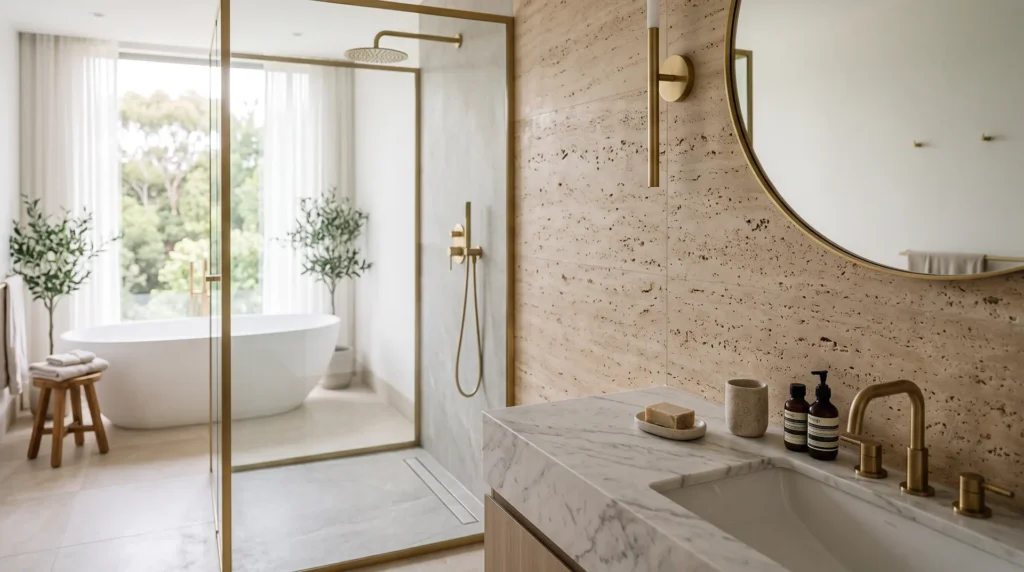
Stone Moods — Buyer’s Guide
Best Stone for Bathroom: The Complete Guide
Marble, quartzite, travertine, limestone, onyx, or granite? The bathroom is not one environment — it’s several, stacked into one room: a splash zone, a standing-water shower floor, and dry vanity surfaces that barely see moisture. This guide cuts through the showroom noise and gives you the unvarnished truth about which stone belongs where.
✓6 stone types compared ✓Water resistance & slip safety ✓Cost per sqft breakdown ✓Expert specification advice
The bathroom is the most water-exposed room in any home. Unlike a kitchen, where the enemy is acid, in a bathroom the enemy is standing moisture, humidity, and — critically — slip risk on wet floors. Choosing the wrong stone means a shower floor that’s genuinely dangerous, or a vanity that stains and dulls within a year. Choosing the right one means decades of a surface that only gets more beautiful.
The answer to “what is the best stone for a bathroom?” depends on which zone you’re specifying — floor, shower, vanity, or wall — and how much upkeep you’re realistically willing to commit to. This guide breaks it down zone by zone.
The honest answer:
For shower and bathroom floors, quartzite or granite in a honed or leathered finish deliver the best combination of water resistance and slip safety — polished stone underfoot in a wet bathroom is a genuine hazard regardless of which stone you choose. For vanities and low-splash walls, marble and travertine deliver the classic spa aesthetic if you accept the maintenance. For a backlit statement wall, nothing replaces onyx.
Quick Comparison: All 6 Stones at a Glance
| Stone | Durability | Moisture Resist. | Maintenance | Cost/sqft | Best for |
|---|---|---|---|---|---|
| Quartzite | ★★★★★ | ★★★★☆ | Medium | $50–$180 | Shower & bathroom floors |
| Granite | ★★★★★ | ★★★★★ | Low | $25–$100 | Low-maintenance floors |
| Marble | ★★★☆☆ | ★★★☆☆ | High | $40–$300+ | Vanities & feature walls |
| Travertine | ★★★☆☆ | ★★☆☆☆ | High | $15–$70 | Warm, spa-style walls |
| Limestone | ★★★☆☆ | ★★☆☆☆ | High | $18–$70 | Low-splash accent walls |
| Onyx | ★★☆☆☆ | ★★☆☆☆ | High | $100–$400+ | Backlit statement walls |
1. Quartzite — The Safest Choice for Wet Floors
HARDNESS: 7 MOHS · MOISTURE RESISTANCE: GOOD · COST: $50–$180/SQFT INSTALLED
Quartzite is the material bathroom designers reach for when a shower floor genuinely needs to perform. Its dense, fused quartz crystal structure gives it low porosity and excellent resistance to standing water and humidity — a critical difference from marble or travertine, which can absorb moisture over time in a poorly ventilated bathroom. It also resists soap scum buildup better than more porous stones.
Specify quartzite in a honed or leathered finish for shower and bathroom floors — never polished. A polished finish, however beautiful, becomes dangerously slick the moment it’s wet.
Best quartzite varieties for bathrooms:
Taj Mahal · Sea Pearl · White Macaubas · Fantasy Brown · Azul Macaubas
⚠ Slip-safety warning: Polished stone floors in a wet bathroom are a genuine fall hazard, regardless of which stone you specify. Always request a honed, leathered, or textured finish for shower floors and wet-zone flooring — save polished finishes for vanities and dry walls.
2. Granite — The Lowest-Maintenance Option
HARDNESS: 6–7 MOHS · MOISTURE RESISTANCE: EXCELLENT · COST: $25–$100/SQFT INSTALLED
Granite’s low porosity and dense mineral structure make it one of the most water-resistant natural stones available, requiring less frequent sealing than marble, travertine, or limestone. It handles humidity, standing water, and daily cleaning products without the anxiety that comes with softer stones.
It’s a particularly strong choice for guest bathrooms, powder rooms, or family bathrooms where upkeep needs to be minimal. It lacks marble’s prestige aesthetic, but darker granite varieties in a honed finish deliver a genuinely elegant, modern bathroom look.
Best granite varieties for bathrooms:
Absolute Black · White Ice · Kashmir White · Bianco Antico
3. Marble — The Classic Spa Aesthetic
HARDNESS: 3–4 MOHS · MOISTURE RESISTANCE: MODERATE · COST: $40–$300+/SQFT INSTALLED
No material says “spa bathroom” the way marble does — the cool touch underfoot, the soft veining catching light off a mirror, the sense of quiet luxury. But marble’s porosity means it absorbs moisture more readily than granite or quartzite, and in a poorly ventilated bathroom, this can lead to water spotting or, over time, mineral staining around fixtures.
Marble performs best on vanities and low-splash walls rather than shower floors, where standing water and constant humidity accelerate wear. If marble is specified for a shower, insist on a honed finish, aggressive sealing, and excellent ventilation.
The marble bathroom protocol: Seal every 6–12 months, more often in a humid climate. Ensure strong bathroom ventilation to limit moisture absorption. Use a honed finish for any wet-zone application. Wipe down standing water after showers where practical.
Best marble varieties for bathrooms:
Carrara Honed · Calacatta Gold · Statuario Venato · Arabescato
4. Travertine — Warm, Textured, Old-World Character
HARDNESS: 3–4 MOHS · MOISTURE RESISTANCE: LOW-MODERATE · COST: $15–$70/SQFT INSTALLED
Travertine’s naturally pitted, textured surface gives it a warm, Mediterranean spa quality that few other stones replicate. Filled and honed travertine works reasonably well on bathroom floors — the texture actually helps with slip resistance — but unfilled, tumbled travertine is more porous and needs diligent sealing to prevent water absorption in shower zones.
Travertine is best suited to bathrooms where the aesthetic goal is warmth and organic texture over crisp, high-gloss luxury. It pairs particularly well with brass fixtures and warm wood vanities.
Best travertine varieties for bathrooms:
Classic Ivory (filled & honed) · Noce Travertine · Silver Travertine
5. Limestone — Soft Minimalism for Low-Splash Zones
HARDNESS: 3 MOHS · MOISTURE RESISTANCE: LOW · COST: $18–$70/SQFT INSTALLED
Limestone brings the same quiet, understated beauty to a bathroom that it brings to a facade — soft greys and creamy beiges with a natural, fossil-flecked texture. It is, however, the most moisture-vulnerable stone on this list, more porous than marble and prone to staining if exposed to standing water regularly.
Reserve limestone for low-splash accent walls, powder rooms, or dry vanity surfaces rather than shower floors or wet walls, where its porosity becomes a genuine liability.
6. Onyx — The Backlit Showstopper
HARDNESS: 3–4 MOHS · MOISTURE RESISTANCE: LOW · COST: $100–$400+/SQFT INSTALLED
Onyx exists in bathroom design for one reason: translucency. Backlit onyx walls — often in a shower or behind a freestanding tub — glow with a warmth no other stone can replicate, making it the single most dramatic material available for a bathroom feature wall.
It is also the most fragile and porous stone on this list, and is almost never specified for flooring. Onyx panels require careful sealing, professional installation with a backing membrane in wet applications, and a genuine commitment to gentle cleaning. Used correctly — as a single accent wall rather than a full wet-zone surface — it delivers a result nothing else can match.
⚠ Installation note: Backlit onyx requires a specialized installation with a resin or fiberglass backing and a properly ventilated light cavity behind the panel. This is a specialist job — confirm your fabricator has direct experience with backlit onyx before committing to the design.
How to Choose: A Decision Framework
Before choosing a stone, answer these four questions honestly:
1. Which zone are you specifying?
Shower or wet floor → quartzite or granite, honed finish. Vanity or dry wall → marble, travertine, or limestone. Statement feature wall → onyx or bookmatched marble.
2. How is the bathroom ventilated?
Strong exhaust fan, good airflow → marble and travertine perform reasonably well. Poor ventilation, high humidity → stick to granite or quartzite to avoid moisture-related issues.
3. How much maintenance will you actually do?
Zero tolerance → granite. Happy to seal annually → quartzite, marble, or travertine. Willing to hire specialist cleaning for a showpiece → onyx.
4. What is the finish, not just the stone?
Polished finishes look stunning but are dangerous on wet floors. Always specify honed, leathered, or textured finishes for any surface underfoot in a shower or bathroom floor.
Calculate Your Bathroom Project Cost
Use the Stone Moods Project Estimator to get an instant cost breakdown for your chosen stone — material, fabrication, installation, and sealing — based on your exact bathroom dimensions.
Ready to Specify Your Bathroom Stone?
Get a real cost breakdown and verify what you’re actually buying before you commit.
Stone Project Estimator
Material Validator
Bookmatch Visualizer
Frequently Asked Questions
What is the most water-resistant natural stone for a bathroom?
Granite and quartzite are the most water-resistant natural stones for bathroom use. Both have low porosity compared to marble, travertine, or limestone, and resist moisture absorption and soap scum buildup significantly better. For shower floors specifically, both should be specified in a honed or leathered finish to ensure slip safety when wet.
Is marble safe for bathroom floors?
Marble can be used on bathroom floors, but it requires more care than granite or quartzite. Its porosity means it absorbs moisture more readily, and a polished finish becomes dangerously slippery when wet. If marble is specified for a bathroom floor, a honed finish, diligent sealing, and strong ventilation are essential. For shower floors specifically, quartzite or granite are generally the safer, lower-maintenance choice.
What stone is best for a walk-in shower?
Quartzite in a honed or leathered finish is generally the best choice for walk-in shower floors, combining strong moisture resistance with slip safety. For shower walls, where slip risk isn’t a factor, marble, travertine, or even backlit onyx can be used to create a more dramatic, spa-like effect.
How much does a natural stone bathroom cost?
Natural stone bathroom costs vary widely by stone type, zone, and finish. As a general benchmark: granite runs $25–$100 per square foot installed; travertine and limestone $15–$70; quartzite $50–$180; marble $40–$300+; and onyx, typically reserved for accent walls, $100–$400+. These figures include material, fabrication, and standard installation. Use the Stone Moods Project Estimator for a detailed breakdown based on your specific bathroom layout.
Related Reading on Stone Moods
- Dolomite vs. Marble: What’s the Difference and Which Should You Choose?
- Marble vs. Porcelain: Which Is Right for Your Project?
- 10 Moody Bathroom Ideas: The Art of Darkness & Stone
- Stone Project Estimator
- Stone Specification Library