
Honed vs. Tumbled Finish: Which Stone Surface Should You Specify?
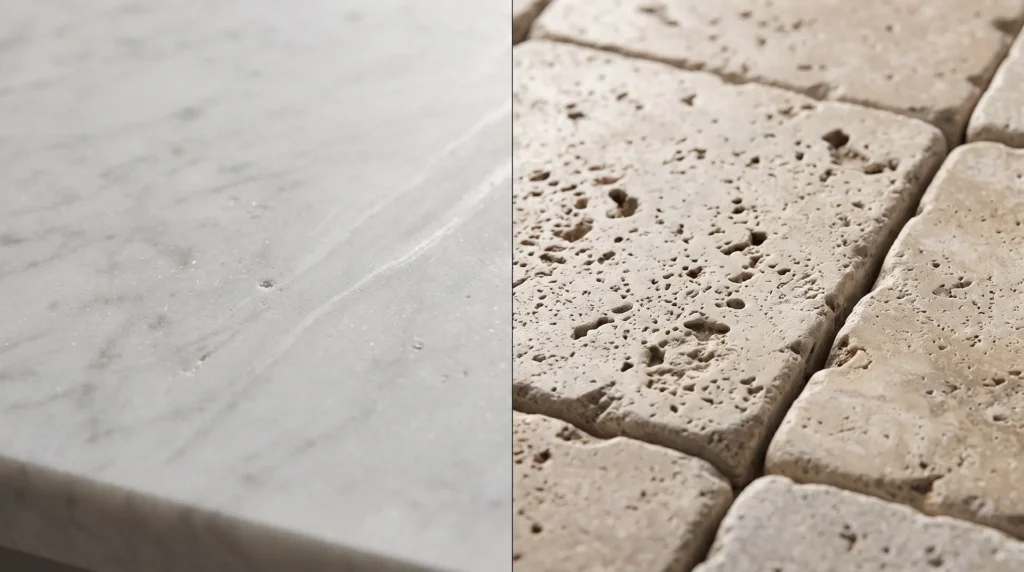
This comparison isn’t about which stone to buy — it’s about what happens to the surface after the stone is already chosen. The same slab of travertine or marble can leave the factory looking completely different depending on how its surface was finished, and honed and tumbled sit at genuinely opposite ends of that process: one is machine-ground flat and smooth, the other is physically worn and rounded in a rotating drum. Neither is “better” in the abstract — they produce different textures for different jobs.
Unlike our stone-vs-stone comparisons, honed and tumbled finishes can technically be applied to many different materials — marble, travertine, limestone, and even some granites. This guide focuses on what the finish itself does to appearance, slip resistance, and maintenance, regardless of which stone underneath it you’ve chosen.
Quick answer:
Honed finish is achieved by grinding the stone to a flat, smooth plane and stopping before the final polishing stage — the result is a matte, non-reflective surface with sharp, clean edges. Tumbled finish is achieved by physically abrading stone pieces against each other in a rotating drum with grit and water, which rounds the edges and pits the surface to create a worn, aged texture. Choose honed for a sleek, modern, low-glare surface on countertops and floors. Choose tumbled for a rustic, old-world texture with strong slip resistance — but not for kitchen countertops, where its porous, pitted surface is a poor fit.
What Each Finish Actually Is
What Is a Honed Finish?
Honing is a mechanical grinding process that flattens and smooths a stone surface using progressively finer abrasive pads, stopping short of the final buffing stage that produces a glossy polish. The result is a flat, matte, low-sheen surface that still feels smooth to the touch — the stone’s true color often reads slightly softer and less saturated than its polished counterpart, since there’s no reflective sheen amplifying the veining or color depth.
What Is a Tumbled Finish?
Tumbling is a batch process, not a grinding process. Cut stone pieces — almost always smaller-format tiles, pavers, or bricks — are loaded into a rotating drum along with abrasive grit, sand, and water, then physically knocked against each other and the drum walls for an extended period. This mechanical abrasion rounds off sharp corners and edges and pits the face of the stone, producing a worn, antiqued texture that looks like it has weathered for decades, not minutes.
- Honed process: Machine-ground flat plane, stopped before polish — smooth, matte, sharp edges retained
- Tumbled process: Batch-abraded in a rotating drum — rounded edges, pitted texture, no flat grinding involved
- Key difference: Honing refines a surface; tumbling deliberately roughens and ages one
Honed vs. Tumbled: Side-by-Side Comparison
| Property | Honed Finish | Tumbled Finish |
|---|---|---|
| Surface texture | Flat, smooth, matte | Pitted, uneven, rounded edges |
| Reflectivity | Low — no gloss | None — fully matte and textured |
| Slip resistance | Good | Very good — texture adds grip |
| Visible etching/scratches | Less visible than polished (no shine to lose) | Least visible of all finishes — texture masks wear |
| Porosity / sealing needs | Similar to polished, same stone | Higher — pits and rounded edges expose more surface |
| Typical format | Slabs and large-format tile | Almost always smaller tile or paver format |
| Aesthetic | Modern, sleek, understated | Rustic, aged, old-world |
| Best avoided on | No major restrictions | Kitchen countertops (too porous/uneven for food prep) |
The Real Difference: Ground Flat vs. Physically Worn
It’s easy to lump honed and tumbled together as “the non-shiny options,” but the mechanism behind each is fundamentally different, and that mechanism is what drives every practical difference between them. Honing is a refinement — the same fabrication line that produces a polished surface simply stops a few grit stages earlier, leaving a flat, smooth, matte plane that’s still dimensionally precise and sharp at the edges.
Tumbling is closer to controlled damage than refinement. The rotating-drum process doesn’t create a flat plane at all — it deliberately introduces irregularity, rounding every corner and pitting the face until the stone looks naturally weathered. This is exactly why tumbled stone is almost never seen in large slab format: the process only works on individually tumbled pieces small enough to move freely and collide inside the drum, which is why tumbled stone shows up as tile and paver, never as a countertop slab.
A labeling caution: Not everything marketed as “tumbled marble” or “tumbled travertine” has actually been through a rotating drum. Some cheaper products are chemically etched or sandblasted to fake the pitted look without genuine edge-rounding — these can look similar in a showroom photo but wear differently and often lack the true rounded-edge durability of authentically tumbled stone. Ask your supplier directly whether the tumbling was mechanical or a surface treatment mimicking the look.
Where to Use Each: Application Guide
Kitchen Countertops
Honed is a genuinely strong, increasingly popular countertop choice — it delivers a modern, low-glare surface that also happens to hide etching better than polished stone, since there’s no shine to visibly dull. Tumbled finish is a poor fit for countertops: its pitted, uneven surface is harder to keep sanitary for food prep and isn’t manufactured in slab format to begin with.
Bathroom and Shower Floors
Both finishes outperform polished stone here on slip safety, but for different reasons. Tumbled’s pitted texture provides excellent grip underfoot even when wet, which is why it’s a long-time favorite for shower floors and bathroom tile — see our Best Stone for Bathroom guide for finish-by-zone recommendations. Honed offers a smoother, easier-to-clean alternative with still-solid slip resistance for anyone who prefers a more contemporary look.
Outdoor Patios and Pool Decks
Tumbled stone’s aged, rustic texture and strong slip resistance make it a classic choice for pool decks and patios, particularly in travertine and limestone — our Best Natural Stone for Pool Decks & Outdoor Pavers guide covers this in more depth. Honed stone also performs well outdoors and suits a more minimalist, contemporary exterior design.
Wall Cladding and Backsplashes
Tumbled tile brings genuine old-world mosaic character to a backsplash or accent wall, particularly in smaller tile formats like brick or subway shapes. Honed cladding delivers a calmer, more uniform backdrop that lets other design elements — cabinetry, fixtures, lighting — carry more of the visual weight.
Cost Comparison
Because honed and tumbled finishes can be applied to many different stones, the base material — marble, travertine, limestone, granite — still drives the majority of total installed cost far more than the finish itself. As a general guide to the finish premium alone:
- Honed finish: Typically neutral to slightly cheaper than polished on the same stone — often $0–$5/sqft difference, since honing skips the final buffing stage rather than adding one.
- Tumbled finish: Typically a $3–$10/sqft premium over the same material in polished or honed tile format, reflecting the extra batch-tumbling labor and generally smaller tile format required.
For actual installed cost on a specific stone, see that stone’s own comparison article, or run your exact numbers with the Stone Moods True Cost Calculator.
Frequently Asked Questions
Is honed or tumbled better for a shower floor?
Both outperform polished stone on slip safety. Tumbled’s pitted texture offers slightly more grip but traps more grime and needs more diligent sealing and cleaning. Honed is smoother and easier to maintain while still providing solid slip resistance — a reasonable middle ground for anyone who wants safety without tumbled’s heavier maintenance.
Does tumbled stone need more sealing than honed?
Generally, yes. Tumbled stone’s pitted surface and rounded, more exposed edges present more surface area for moisture and staining agents to penetrate compared to a flat honed surface on the same stone, so it typically benefits from more frequent or more thorough sealing.
Can any stone be tumbled?
Most softer to medium-hardness stones — travertine, marble, limestone — tumble well and are the materials most commonly finished this way. Very hard stones like granite are rarely tumbled, since the physical abrasion required to round their edges is far more labor- and time-intensive, making it an uncommon and expensive request.
Is honed finish less durable than polished?
No — durability against scratching and etching is a property of the stone’s mineral hardness, not the finish applied to it. Honed and polished versions of the same stone have identical underlying resistance; the finish only changes reflectivity and how visible surface wear appears over time, not the wear itself.
Choosing a Finish for Your Project?
Compare real installed costs and confirm which finish actually fits how the space will be used before you commit.
True Cost Calculator
Material Validator
Maintenance Reality Score
Related Reading on Stone Moods
- Stone Finishes Glossary: Polished, Honed, Leathered & More
- Best Stone for Bathroom: The Complete Guide
- Best Natural Stone for Pool Decks & Outdoor Pavers: The Complete Guide
- Stone Specification Library