
Stone Moods — Outdoor Guide
Best Natural Stone for
Pool Decks & Outdoor Pavers
Travertine, limestone, granite, quartzite, or bluestone? Outdoor stone has to survive heat, water, frost, and barefoot traffic. This guide tells you exactly which stone works — and which ones fail — in the most demanding environment in residential design.
✓Slip resistance ratings explained
✓Heat & frost performance
✓Pool coping & paver guide
Outdoor stone is where specification mistakes become expensive. A beautiful stone that looks stunning in a showroom can crack in the first winter frost, become dangerously slippery when wet, or turn unbearably hot under a summer sun. The outdoor environment is unforgiving — and the performance requirements for pool decks, outdoor pavers, and coping are completely different from any interior application.
This guide covers everything you need to know: which stones perform in wet and high-heat conditions, how slip resistance ratings work, which finishes to specify for safety, and how to choose between the leading options for pool decks, garden paths, terraces, and coping.
The short answer: Travertine and limestone are the classic pool deck choices — cool underfoot, naturally slip-resistant, and beautiful. Granite and quartzite outperform both in durability and frost resistance. For modern, minimal aesthetics with zero compromise on performance, large-format granite or quartzite pavers are the professional’s choice.
What Makes Outdoor Stone Different
Interior stone is protected. Outdoor stone faces four forces that interior stone never encounters:
☀️
Heat absorption
Dark stones in direct sun can reach 70°C+ — unbearable barefoot. Light-coloured, porous stones stay measurably cooler.
💧
Water & slip
Polished stone becomes dangerous when wet. Pool decks require minimum R10 slip rating — ideally R11 or brushed finish.
❄️
Freeze-thaw cycles
Water absorbed into porous stone expands when it freezes, fracturing the surface. Low-absorption stones are essential in cold climates.
🧪
Pool chemicals
Chlorine and pH-adjusting chemicals splash and evaporate onto coping and deck surfaces. Acid-sensitive stones will etch and dull over time.
Slip Resistance: What the Ratings Mean
Slip resistance is measured using the R-value scale (DIN 51130), which rates surfaces from R9 (slightly slip-resistant) to R13 (highly slip-resistant). For pool decks and wet outdoor areas, a minimum of R10 is required in most building codes — R11 is the professional standard for pool surrounds where barefoot traffic is expected.
| R-Rating | Classification | Suitable for | Pool deck? |
|---|---|---|---|
| R9 | Low slip resistance | Dry indoor areas only | ✗ Not suitable |
| R10 | Moderate slip resistance | Wet areas, light outdoor | △ Minimum acceptable |
| R11 | Good slip resistance | Pool decks, terraces | ✓ Recommended |
| R12–R13 | High slip resistance | Commercial pools, water parks | ✓ Commercial standard |
All 5 Stones Compared
| Stone | Heat | Slip (brushed) | Frost resist. | Pool chemicals | Cost/sqft |
|---|---|---|---|---|---|
| Travertine | ★★★★★ | R11 | Moderate | Moderate | $15–$50 |
| Limestone | ★★★★★ | R11 | Low | Poor | $12–$45 |
| Granite | ★★★☆☆ | R11–R12 | Excellent | Excellent | $20–$60 |
| Quartzite | ★★★☆☆ | R11 | Excellent | Excellent | $30–$90 |
| Sandstone | ★★★★☆ | R11–R12 | Moderate | Moderate | $10–$35 |
1. Travertine — The Pool Deck Classic
HARDNESS: 3–4 MOHS · HEAT: EXCELLENT · SLIP: R11 BRUSHED · COST: $15–$50/SQFT
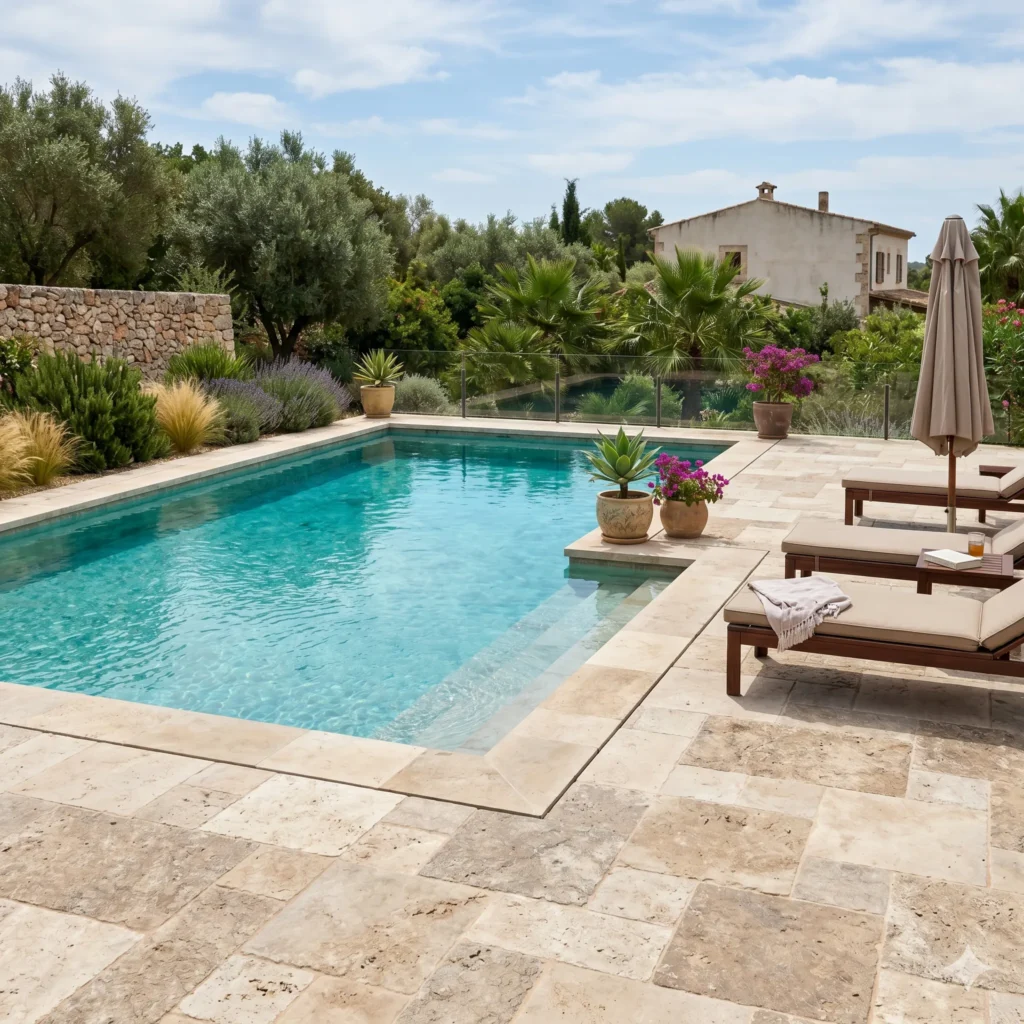
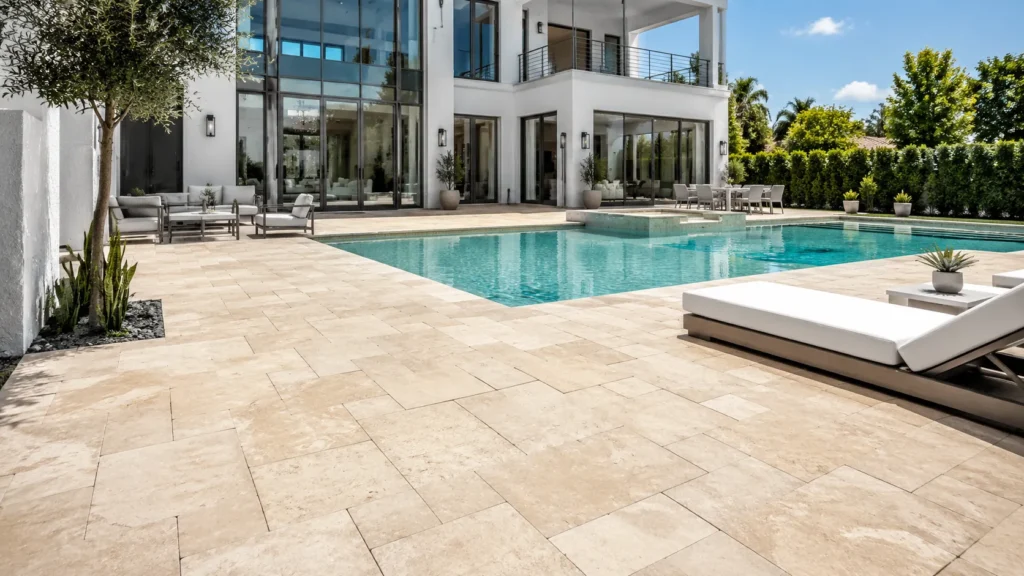
Travertine is the most widely used natural stone for pool decks globally — and for very good reason. Its porous, sedimentary structure gives it two critical properties that make it uniquely suited to the pool environment: it stays cool underfoot even in direct sun, and its naturally textured surface provides excellent slip resistance when wet without any additional treatment.
Travertine’s warm, creamy tones — ranging from ivory and beige to walnut and noce — complement water and landscaping beautifully. It has been the dominant stone in luxury residential pool design for decades, and its biophilic character is only becoming more relevant as design trends move toward natural, textured surfaces.
The limitations to know: Travertine is a carbonate stone — it will react to chlorine exposure and acid rain over time, gradually dulling and pitting the surface. In climates with hard winters, its porosity makes it vulnerable to freeze-thaw damage unless properly sealed. For pool decks in mild climates, these limitations are manageable. In cold northern climates, granite or quartzite may be a stronger long-term specification.
Specification notes for travertine pool decks:
→ Always specify brushed or tumbled finish — never polished or honed for outdoor use
→ Use filled travertine for pool decks — unfilled voids collect water and debris
→ Seal annually with a penetrating impregnator rated for outdoor use
→ Best varieties: Silver Travertine, Classic Cream, Noce Travertine, Walnut Travertine
2. Limestone — Elegant but Climate-Dependent
HARDNESS: 3 MOHS · HEAT: EXCELLENT · SLIP: R11 · COST: $12–$45/SQFT
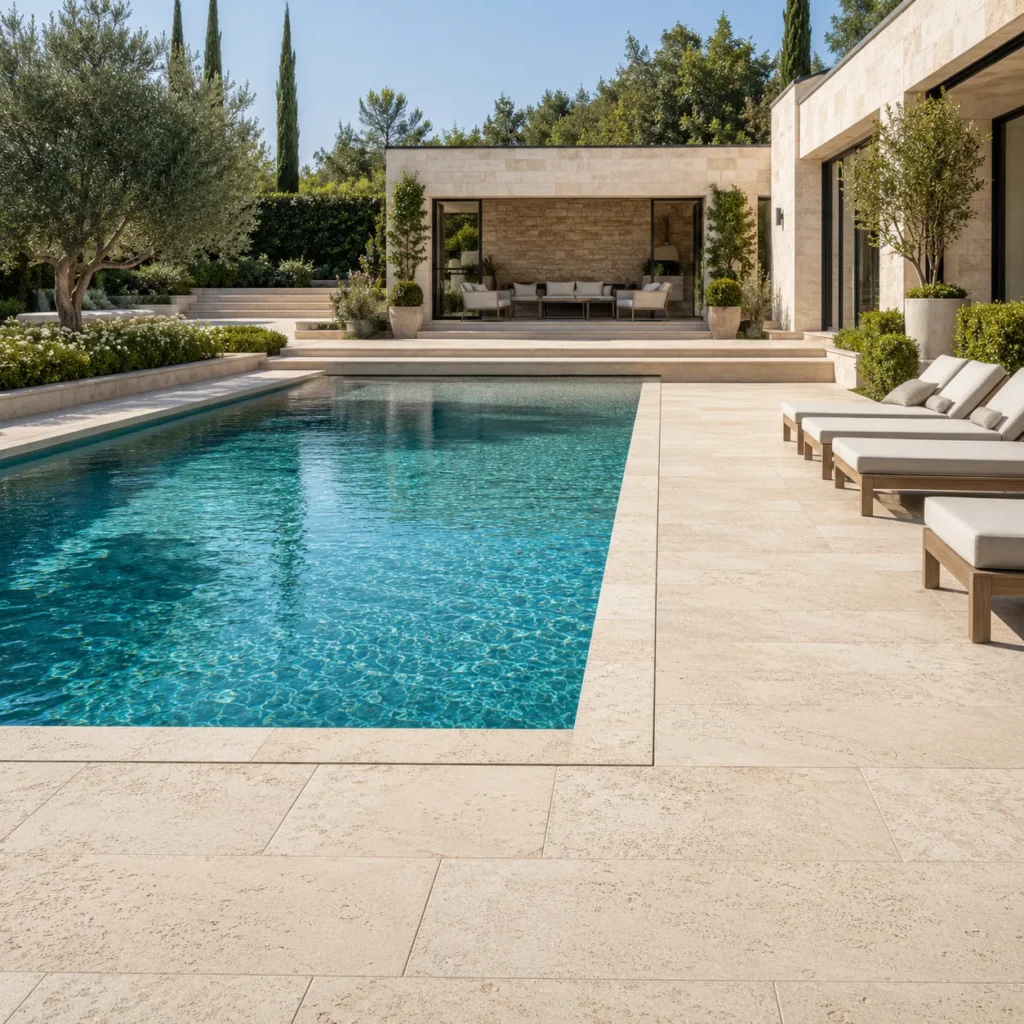
Limestone shares travertine’s best outdoor qualities — cool underfoot, naturally textured, and beautiful in a garden or poolside context. Its subtle, understated palette of greys, creams, and sandy beiges makes it particularly popular in contemporary and Mediterranean landscape design.
However, limestone is the most climate-sensitive natural stone for outdoor use. Its high porosity and carbonate composition make it vulnerable to freeze-thaw cracking, acid rain weathering, and chlorine degradation. It is an excellent specification in warm, dry climates — the Mediterranean, the Middle East, Southern California, Florida — and a risky one in temperate or cold climates with significant rainfall or frost.
Climate warning: Do not specify limestone for pool decks or outdoor pavers in climates with freezing winters or significant acid rain exposure. Water absorption rates above 3% indicate high freeze-thaw risk — always request the absorption test certificate from your supplier.
3. Granite — The Most Durable Outdoor Stone
HARDNESS: 6–7 MOHS · HEAT: MODERATE · SLIP: R11–R12 · COST: $20–$60/SQFT
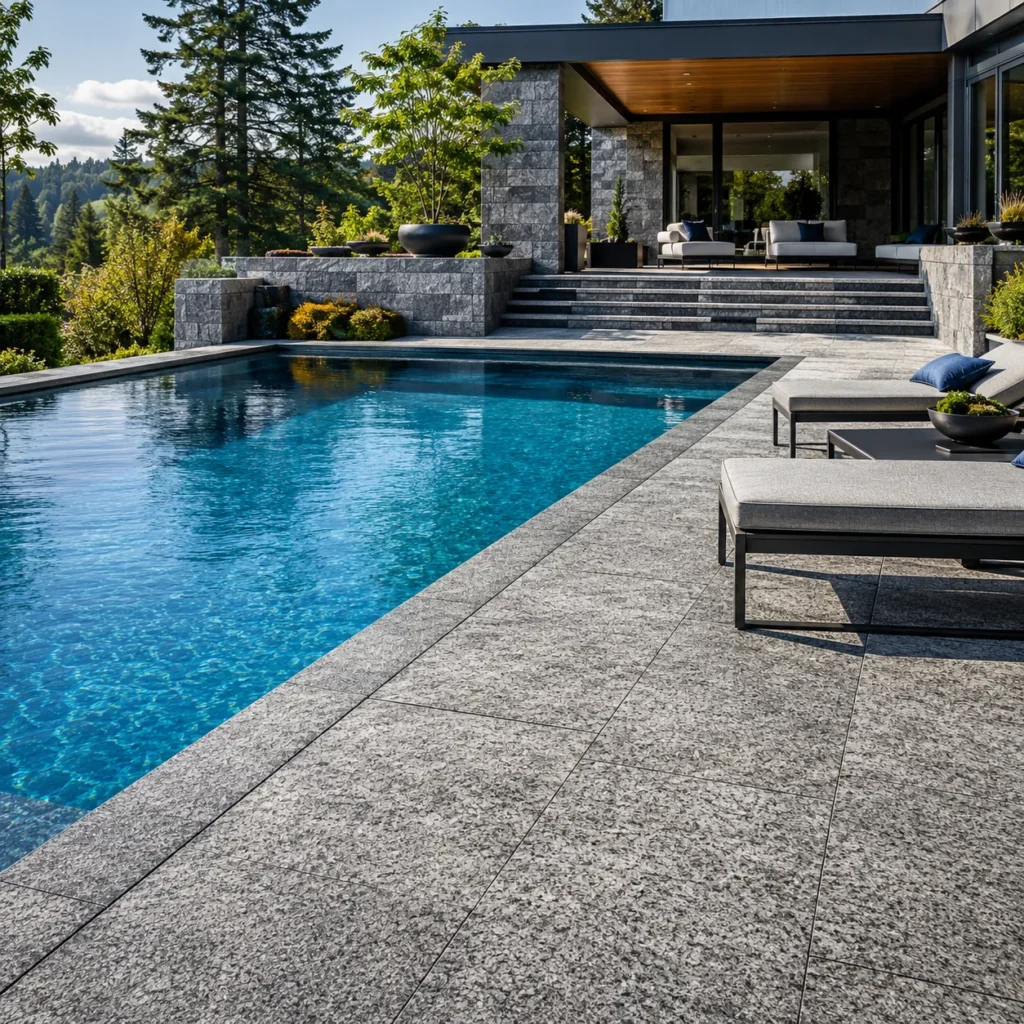
Granite is the most technically capable outdoor stone. Its igneous, siliceous composition makes it virtually impervious to acid, chlorine, and chemical exposure. Its low water absorption (typically below 0.5%) gives it outstanding freeze-thaw resistance — it performs in climates where travertine and limestone simply cannot. It is harder than any other natural stone in outdoor use, resisting scratching, impact, and heavy foot traffic for decades without degradation.
The limitation of granite for pool decks is heat absorption. Dark granite varieties absorb significant solar radiation and can become uncomfortably hot underfoot in summer. Light-coloured granite — White Crystal, Silver Grey, Bianco Sardo — mitigates this substantially. A flamed or sandblasted finish dramatically reduces heat retention compared to polished granite.
Specification notes for granite outdoor pavers:
→ Always specify flamed, sandblasted, or bush-hammered finish for outdoor use — not polished
→ Choose light colours for pool decks to minimise heat absorption
→ Granite requires minimal sealing — once every 3–5 years is sufficient
→ Best varieties: Silver Grey, White Crystal, Bianco Sardo, G654 Padang Dark (in shade), Tiger Skin
4. Quartzite — Premium Performance Outdoors
HARDNESS: 7 MOHS · HEAT: MODERATE · SLIP: R11 · COST: $30–$90/SQFT
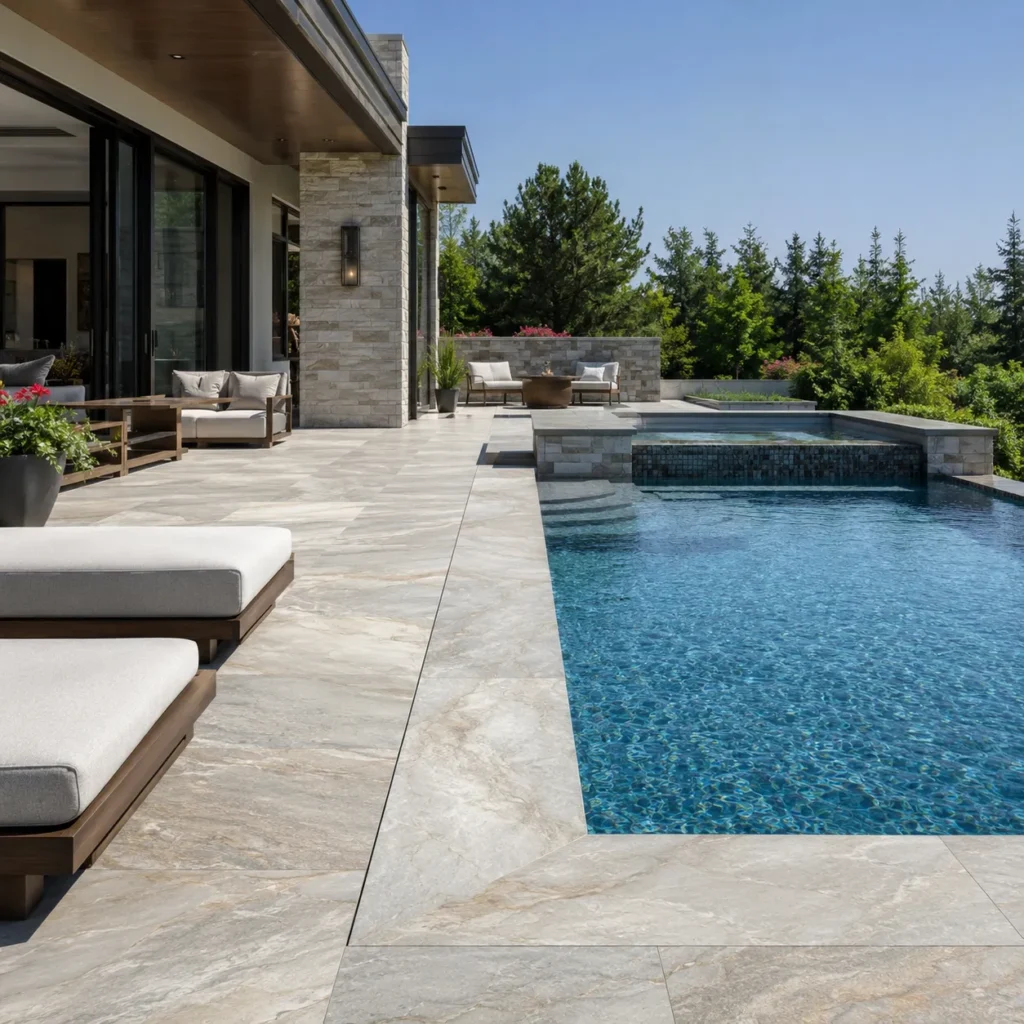
Quartzite combines the durability advantages of granite with more refined, marble-like aesthetics. In outdoor applications, particularly for luxury residential terraces, pool surrounds, and feature paving, quartzite delivers a level of visual refinement that granite’s typically granular texture cannot match.
Its extremely low water absorption and acid-resistant siliceous composition make it an excellent specification for pool coping, where prolonged contact with chlorinated water would degrade carbonate stones. For premium outdoor projects in any climate, quartzite is increasingly the professional’s first choice.
Best quartzite varieties for outdoor use:
Perla Venata · White Macaubas (brushed) · Fantasy Brown · Azul Macaubas · Sea Pearl · Montclaire
5. Sandstone — Character-Rich Budget Option
HARDNESS: 6–7 MOHS · HEAT: GOOD · SLIP: R11–R12 · COST: $10–$35/SQFT
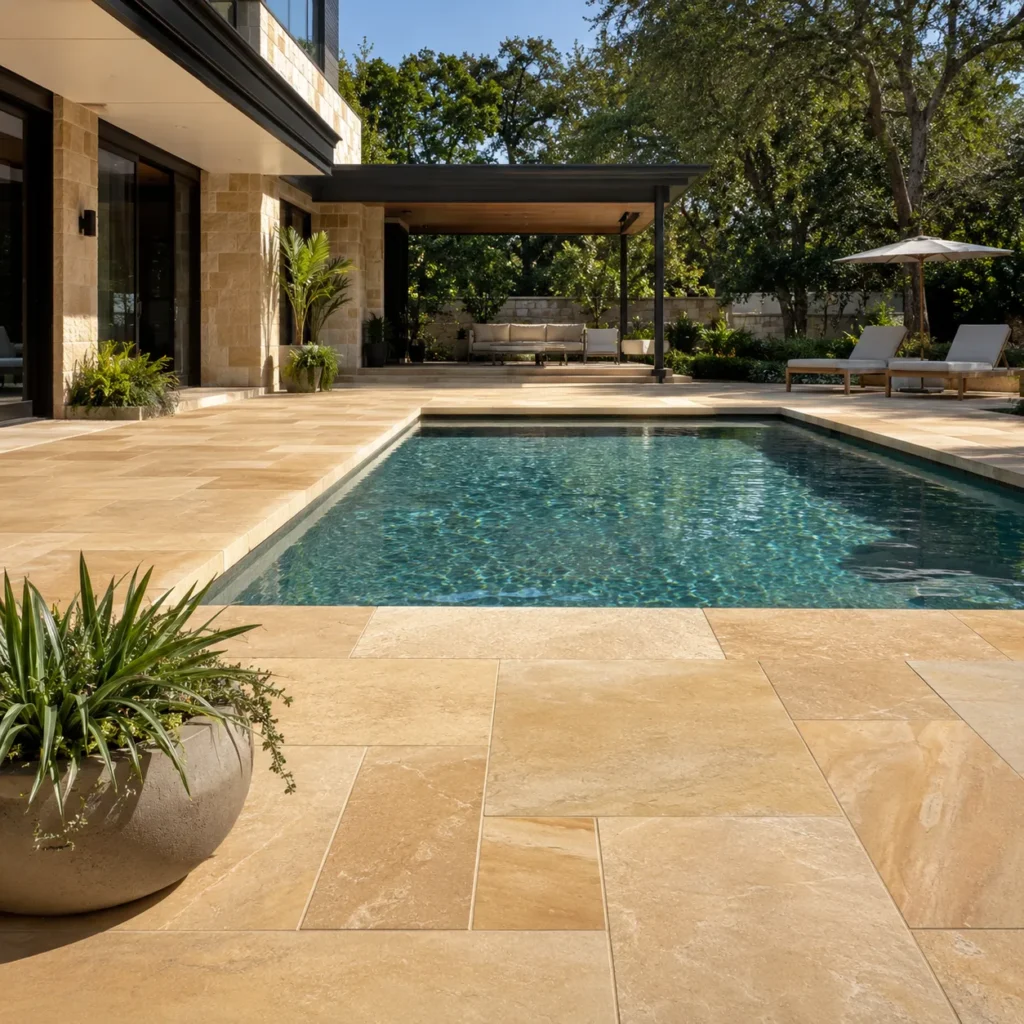
Sandstone is the most affordable natural stone for outdoor paving, and in the right context it delivers a rustic, organic character that no other stone replicates. Its naturally rough texture provides excellent slip resistance, its warm tones age gracefully in garden environments, and its siliceous composition gives it reasonable durability and moderate frost resistance.
Sandstone is best suited to garden paths, informal terraces, and landscape paving rather than formal pool decks or luxury outdoor spaces. Its softer, more rustic aesthetic makes it a less natural fit for contemporary architecture, but it remains a compelling choice for traditional and naturalistic garden design on a measured budget.
Best sandstone varieties for garden pavers:
Indian Sandstone (Raj Green, Autumn Brown) · Buff Sandstone · York Stone · Caramel Sandstone
Pool Coping: A Separate Specification
Pool coping — the stone cap that forms the edge of the pool — faces more demanding conditions than the surrounding deck. It is in direct, prolonged contact with pool water and chemicals, subject to repeated wet-dry cycles, and must withstand physical impact from swimmers.
Best coping stones
Granite and quartzite are the strongest performers for coping — acid-resistant, low absorption, and durable under chemical exposure. Travertine is acceptable in mild climates with diligent sealing. Limestone and marble should be avoided for coping.
Coping finish
Always specify a bullnose or drop-face edge profile for safety — sharp or square edges are a hazard for swimmers. Honed or brushed surface finish provides grip; polished is unacceptable for coping.
Coping thickness
Standard coping thickness is 30–40mm for residential pools. Thin stone (under 20mm) is not suitable for coping applications — it is vulnerable to impact and thermal stress at the pool edge.
Which Finish for Outdoor Stone?
| Finish | Slip rating | Heat | Pool deck? | Notes |
|---|---|---|---|---|
| Polished | R9 — dangerous wet | High | ✗ Never | Indoor only |
| Honed | R10 — marginal | Medium | △ With caution | Dry pool surrounds only |
| Brushed | R11 — good | Low–medium | ✓ Recommended | Best balance of look and safety |
| Flamed | R11–R12 | Low | ✓ Excellent | Granite only — very textured |
| Tumbled | R11 | Low | ✓ Good | Travertine & limestone — rustic look |
Calculate Your Outdoor Project Cost
Use the Stone Moods Project Estimator to get an instant cost breakdown for your pool deck or outdoor paving project — material quantity, waste factor, installation, and sealing included.
Frequently Asked Questions
What is the best natural stone for a pool deck?
Travertine is the most popular natural stone for pool decks globally, offering excellent heat performance, natural slip resistance, and a timeless aesthetic. For colder climates or projects requiring maximum durability, granite or quartzite are superior choices due to their low water absorption and resistance to freeze-thaw damage and pool chemicals. The best stone depends on your climate, budget, and aesthetic preferences — in warm climates, travertine is hard to beat; in cold climates, granite or quartzite are the stronger specification.
Does travertine get hot in the sun around a pool?
Travertine is one of the coolest natural stone surfaces in direct sunlight, which is a primary reason for its dominance in pool deck specification. Its porous, light-coloured surface reflects rather than absorbs solar radiation, staying significantly cooler than dark stone, concrete, or porcelain alternatives. In very hot climates (desert environments, extreme summer heat), even travertine can become warm underfoot during peak sun hours, but it remains measurably cooler than any dark stone or non-porous surface of similar colour.
What stone is best for outdoor pavers in a cold climate?
For cold climates with freezing winters, granite is the most reliable outdoor paver. Its extremely low water absorption (typically under 0.5%) prevents water penetration and the freeze-thaw cracking that damages more porous stones like travertine, limestone, and sandstone. Quartzite is also an excellent choice for cold climates, offering similar low absorption with more refined aesthetics. When specifying any stone for freeze-thaw environments, always request the water absorption test certificate and confirm the stone meets EN 12371 frost resistance standards.
How often does outdoor stone need to be sealed?
Sealing frequency depends on the stone type and the outdoor environment. Travertine and limestone pool decks should be sealed annually with a premium penetrating impregnator rated for outdoor use. Granite pavers require sealing every 3–5 years due to their low natural porosity. Quartzite falls between the two — every 2–3 years is a reasonable maintenance interval. In all cases, the water bead test is the best indicator: if water no longer beads on the surface, it is time to reseal. Always clean the surface thoroughly before applying sealer.