
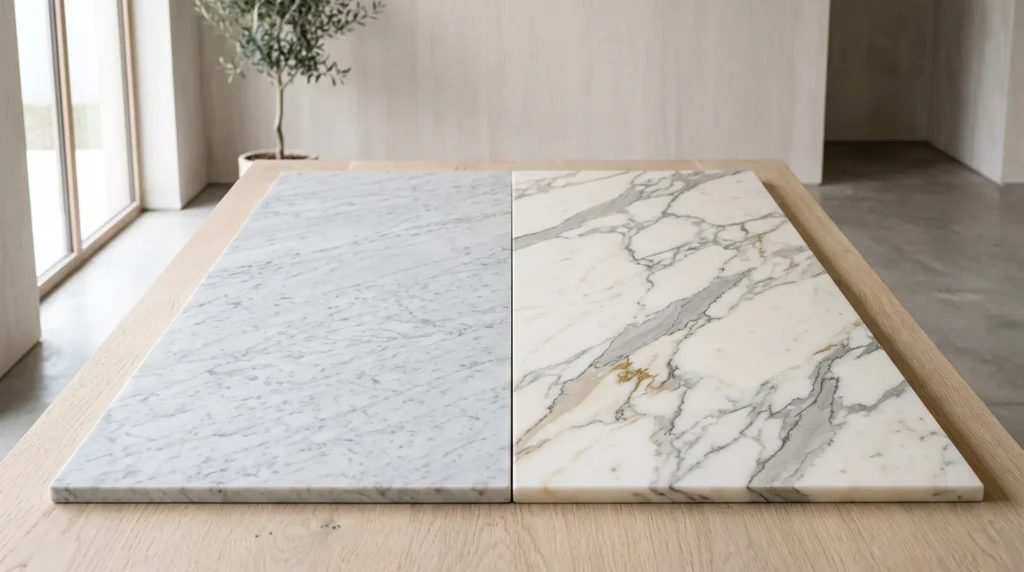
Calacatta vs. Carrara Marble: The Definitive Comparison
They come from the same mountains, sometimes the same quarry district, and salespeople confuse them constantly — but Calacatta and Carrara are not the same marble, and the price gap between them can be three to four times per square foot. If you have ever been quoted “Calacatta” pricing for a stone that looks suspiciously like plain white-and-grey Carrara, this guide will help you tell the difference before you sign a contract.
Both are Italian marbles from the Apuan Alps in Tuscany. Both are calcite-based. Both can appear in a showroom labeled with confusing hybrid names like “Calacatta Carrara” that mean almost nothing geologically. This guide breaks down what actually separates them — background tone, vein character, rarity, and cost — so you can specify with confidence.
Quick answer:
Carrara is the workhorse: a soft grey-white marble with fine, feathery, closely-spaced veining, abundant in supply, and comparatively affordable. Calacatta is the showpiece: a brighter, whiter background with bold, dramatic, widely-spaced veining, quarried in far smaller volumes, and priced accordingly. If your budget is tight or you need large quantities, Carrara delivers real marble at a real price. If the design calls for a dramatic feature — a waterfall island, a bookmatched wall — and budget allows, Calacatta is the one that stops people in a room.
Geology First: Same Mountains, Different Stone
What Is Carrara Marble?
Carrara marble is quarried in and around the city of Carrara in the Apuan Alps, from a network of quarries that has been worked continuously since Roman times — the same general district that supplied stone for the Pantheon and much of Michelangelo’s sculptural work. It is composed almost entirely of calcite (CaCO₃), with very fine, uniform crystal structure that gives it a soft, slightly translucent grey-white background. Carrara is, by volume, the most widely quarried and traded marble in the world.
What Is Calacatta Marble?
True Calacatta comes from a much smaller number of quarries in the same Apuan Alps region — historically concentrated around Fantiscritti and Crestola, near Carrara itself. It is also calcite-based, but the crystal structure and mineral impurities differ enough to produce a distinctly whiter, brighter background and bolder, thicker veining. Calacatta blocks are rarer, yield less usable slab per block, and the quarries themselves produce a far smaller annual volume than Carrara’s.
- Carrara composition: Calcite (CaCO₃) — fine, uniform crystal structure
- Calacatta composition: Calcite (CaCO₃) — coarser structure, higher brightness, lower impurity distribution
- Key difference: Not chemical, but structural and visual — background whiteness, vein boldness, and quarry yield
Calacatta vs. Carrara: Side-by-Side Comparison
| Property | Carrara Marble | Calacatta Marble |
|---|---|---|
| Background color | Soft grey-white, sometimes blue-grey | Bright, warm white |
| Veining character | Fine, feathery, densely spaced, subtle | Bold, thick, widely spaced, dramatic |
| Vein color | Soft grey | Grey and/or gold-tinted |
| Mohs hardness | 3–4 | 3–4 |
| Water absorption | 0.1–0.5% | 0.1–0.5% |
| Quarry yield | High — widely available | Low — limited annual output |
| Slab consistency | Fairly consistent across blocks | Highly variable — every block is different |
| Sealing required | Yes — every 1–2 years | Yes — every 1–2 years |
| Typical price range | $40–$100/sqft installed | $150–$400+/sqft installed |
The Real Difference Is in the Veining
Hardness and water absorption are nearly identical between the two — this is not a durability debate. The distinction that actually matters is visual, and it comes down to how the veining behaves.
Carrara’s veining is soft and linear, often described as “feathery” or “misty.” The veins run in relatively consistent, parallel directions and rarely create sharp contrast against the background. This is what makes Carrara so easy to live with at scale — large expanses of Carrara read as calm and cohesive rather than busy.
Calacatta’s veining is the opposite: bold, angular, often branching in dramatic directions with high contrast against the brighter white background. A single Calacatta slab can contain veins that vary from hairline to several centimeters thick within the same piece. This is precisely why Calacatta commands premium pricing — every slab is effectively a unique art piece, and bookmatching two Calacatta slabs across an island or wall creates a mirrored, symmetrical drama that Carrara’s subtler pattern cannot replicate.
A note on naming: The stone trade is full of names like “Calacatta Carrara,” “Calacatta Borghini,” and “Statuarietto” — some are legitimate quarry-specific varieties, others are marketing labels applied to stones that are structurally closer to Carrara. If a slab is priced like Carrara but marketed as Calacatta, ask for the specific quarry name and origin documentation before assuming you are getting true Calacatta character.
Where to Use Each: Application Guide
Kitchen Countertops and Islands
Both perform identically from a durability standpoint — neither is more scratch- or etch-resistant than the other, since the underlying mineralogy is the same. The decision here is purely visual and budgetary. Carrara is the more forgiving choice for full-kitchen coverage: its subtle, repeating pattern doesn’t fight for attention across countertops, backsplash, and island simultaneously. Calacatta is frequently reserved for a single statement surface — a waterfall island, for example — with a quieter material used elsewhere in the same kitchen to let the Calacatta stand out.
Bathroom Walls and Vanities
This is where Calacatta’s premium is most often justified. A bookmatched Calacatta wall behind a freestanding tub, or a Calacatta vanity top under a large mirror, delivers a boutique-hotel effect that Carrara — while still beautiful — reads as more understated. For full-room cladding on a budget, Carrara achieves a genuinely luxurious result at a fraction of the cost.
Feature Walls and Fireplace Surrounds
Both work well, but the design intent should drive the choice. If the goal is a quiet, cohesive backdrop, Carrara is the better fit. If the fireplace or wall is meant to be the visual anchor of the room, Calacatta’s boldness earns its cost. Use Stone Moods’ Bookmatch Visualizer to preview how either stone’s veining will mirror across a two-slab installation before committing to fabrication.
Large-Format Flooring
Carrara is the more practical and far more common choice for flooring, particularly at scale, simply due to cost and slab availability. Calacatta flooring exists in ultra-high-end residential and hospitality projects, but the cost of covering large square footage with true Calacatta is significant, and busy veining underfoot can visually compete with furniture and rugs in a way it doesn’t on a vertical surface.
Cost Comparison: Why Calacatta Costs So Much More
The price gap between these two marbles is almost entirely a function of quarry yield and slab consistency, not durability or performance:
- Carrara (standard commercial grade): $15–$40/sqft material; $40–$70/sqft installed
- Carrara (select/premium grade): $40–$70/sqft material; $70–$100/sqft installed
- Calacatta (entry — often “Calacatta-style” or blended-origin): $80–$150/sqft material; $120–$180/sqft installed
- Calacatta (true quarry-verified, mid-grade): $150–$250/sqft material; $180–$280/sqft installed
- Calacatta (top-tier, e.g. Calacatta Oro, Calacatta Borghini): $250–$450+/sqft material; $300–$500+/sqft installed
The gap widens further with bookmatching: because Calacatta blocks are rarer and less consistent, sourcing two consecutive slabs with matching veining for a bookmatch installation is significantly harder — and fabricators typically charge a premium for the matching and layout work involved.
Run your exact project numbers — including waste percentage, edge profiles, and installation — with the Stone Moods True Cost Calculator.
How to Verify What You’re Actually Buying
Because “Calacatta” is used loosely across the trade, verifying the slab in front of you is worth the extra ten minutes:
- Ask for the specific quarry name — not just “Calacatta,” but the block or quarry reference (e.g. Calacatta Oro, Calacatta Vagli, Calacatta Borghini). Reputable suppliers can provide this.
- Compare background whiteness in person, not on a screen. Screens and even showroom lighting can make Carrara look whiter than it is. Ask to view the slab under natural daylight if possible.
- Look at vein spacing and thickness. If the “Calacatta” slab in front of you has fine, closely-packed, feathery veining, you are very likely looking at Carrara or a Carrara-Calacatta hybrid, not true Calacatta.
- Check the price against the market range above. If a slab is priced at $50–$70/sqft but marketed as Calacatta, treat that as a red flag and ask direct questions before proceeding.
Frequently Asked Questions
Is Calacatta just expensive Carrara?
Not exactly. They share the same general geographic origin and calcite-based mineralogy, but Calacatta comes from a distinct, smaller set of quarries and has genuinely different structural characteristics — a brighter background and bolder veining — not simply a higher grade of the same material. That said, the trade does use “Calacatta” loosely, and some stones sold under that name are closer to premium Carrara. Always verify quarry origin if the distinction matters to your budget or design intent.
Is Calacatta more durable than Carrara?
No. Both are calcite marbles with nearly identical hardness (Mohs 3–4) and water absorption. Neither is more scratch- or etch-resistant than the other, and both require the same sealing and maintenance routine. The price difference reflects rarity and aesthetics, not performance.
Can I use Carrara to save money and still get a luxury look?
Yes, and this is a common, sensible specification strategy. Carrara delivers genuine natural marble luxury at roughly a quarter to a third of true Calacatta’s cost. Many designers use Carrara throughout a space and reserve a small amount of Calacatta — a single island, a vanity top — as a deliberate splurge where its boldness will be seen and appreciated most.
Why do two Calacatta slabs from the same order sometimes look completely different?
This is a defining, expected characteristic of Calacatta, not a defect. Because the quarries yield less material and the veining is naturally irregular and dramatic, slab-to-slab variation is significantly higher than with Carrara. This is why in-person slab selection — and, for large projects, reserving specific numbered slabs — is strongly recommended for any Calacatta order.
Choosing Between Calacatta and Carrara for Your Project?
Stone Moods’ professional toolkit helps you specify with confidence — check real installed costs, preview bookmatched veining, and confirm technical compatibility before you commit.
Related Reading on Stone Moods
- Dolomite vs. Marble: What’s the Difference and Which Should You Choose?
- Marble vs. Porcelain: Which Is Right for Your Project?
- Marble vs. Quartz 2026: The Definitive Comparison Guide
- Stone Specification Library