
Dolomite vs. Marble: What’s the Difference — and Which Should You Choose?
Walk into most stone showrooms and you will find dolomite slabs sitting next to marble, labeled similarly, priced comparably, and looking nearly identical. Yet these two stones have different geological origins, different performance profiles, and different long-term behaviors. Confusing them — or choosing one without understanding the other — is one of the most common and costly mistakes in stone specification.
This guide gives you the complete picture: geology, hardness, etching behavior, cost, maintenance, and the exact use cases where dolomite outperforms marble and vice versa. Whether you are an architect, a stone buyer, or a homeowner making a final decision, this is the comparison you need before committing.
Quick answer:
Dolomite is harder and more acid-resistant than marble — making it a stronger performer in kitchens and high-use areas. Marble offers greater visual depth and prestige, particularly in premium varieties. Both are natural stones requiring sealing, but dolomite forgives more. If you want marble aesthetics with slightly better durability, dolomite is a compelling alternative.
Geology First: How Are Dolomite and Marble Actually Different?
What Is Marble?
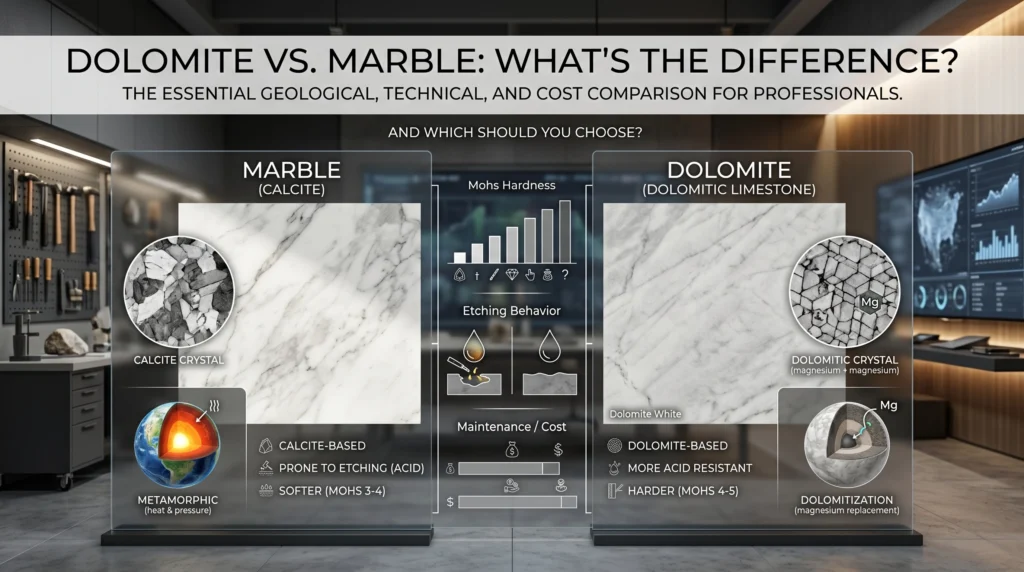
Marble is a metamorphic rock — limestone that has been transformed by intense heat and pressure deep within the Earth. During this process, the calcite crystals in the limestone recrystallize into larger, interlocking grains, producing marble’s characteristic smooth, luminous surface. Mineral impurities introduced during formation create the veining patterns we associate with varieties like Calacatta, Statuario, and Emperador. Marble is composed predominantly of calcite (CaCO₃).
What Is Dolomite?
Dolomite (also called dolostone in its sedimentary form, or dolomitic marble when metamorphosed) is composed primarily of calcium magnesium carbonate — CaMg(CO₃)₂. The magnesium content is the key distinction. Dolomite forms when magnesium-rich fluids replace some of the calcium in limestone or marble during diagenesis. The result is a stone that looks very similar to marble — often with delicate grey, white, or beige veining — but has a slightly different crystal structure that makes it measurably harder and more resistant to acid etching.
Well-known dolomite varieties in the stone trade include Super White Dolomite (Brazil), Bianco Superiore, and Mont Blanc Dolomite. Many of these are marketed and sold as marble in showrooms — a source of significant confusion in the industry.
- Marble composition: Calcite (CaCO₃) — 90–99%
- Dolomite composition: Calcium magnesium carbonate CaMg(CO₃)₂ — 50–90%+
- Key difference: Magnesium content in dolomite changes its crystalline structure and acid reactivity
Technical Properties: Dolomite vs. Marble
| Property | Natural Marble | Dolomite |
|---|---|---|
| Primary mineral | Calcite (CaCO₃) | Calcium magnesium carbonate CaMg(CO₃)₂ |
| Mohs hardness | 3–4 | 3.5–4.5 (slightly harder) |
| Acid resistance | Low — etches quickly with acids | Moderate — more resistant, but not immune |
| Scratch resistance | Low to moderate | Moderate (slightly better than marble) |
| Water absorption | 0.1–0.5% | 0.1–0.4% |
| Polishability | Excellent — high mirror gloss | Very good — slightly less gloss depth |
| Veining aesthetics | Bold, dramatic, unique per slab | Subtle, soft, often grey/white tones |
| Fabrication | Standard — widely understood | Standard — similar to marble |
| Sealing required | Yes — every 1–2 years | Yes — every 1–2 years |
| Typical price range | $40–$300+/sqft installed | $35–$180/sqft installed |
The Critical Difference: Etching and Acid Sensitivity
This is where dolomite and marble diverge most meaningfully in real-world use. Both stones contain carbonates, which react with acids — but dolomite reacts more slowly due to its magnesium content.
In practical terms: spill lemon juice on a polished marble countertop and you will see a dull ring within minutes. The same spill on a dolomite surface will cause less visible damage, and the reaction will progress more slowly. This does not make dolomite acid-proof — it is not — but it provides a meaningful practical advantage in kitchen environments where acidic foods and drinks are a daily reality.
The acid test (literally): Stonemasons and geologists use dilute hydrochloric acid to distinguish calcite marble from dolomite in the field. Calcite marble fizzes vigorously on contact. Dolomite fizzes weakly or only when powdered. This simple test reveals what the naked eye cannot: the true mineralogy beneath the surface.
Industry note: Many slabs sold as “dolomite marble” or “white marble” in showrooms are actually dolomitic marble — a stone with mixed calcite and dolomite content. Always ask your supplier for the mineralogy report or XRF analysis if acid resistance is a specification priority.
Aesthetics: Does Dolomite Look Like Marble?
To the untrained eye, many dolomite varieties are indistinguishable from white marble. Super White Dolomite — one of the most popular stones in contemporary luxury interiors — has a bright white background with soft grey veining that closely resembles Carrara or Thassos marble. It photographs beautifully and has become a staple of Instagram-era kitchen design precisely because it delivers a marble look with more forgiving performance.
The aesthetic differences, when they exist, tend to be subtle:
- Marble often has greater translucency — light penetrates slightly into the stone, creating depth
- Premium marbles like Calacatta Gold have more dramatic, complex veining than most dolomite varieties
- Dolomite tends toward softer, more diffuse vein patterns — elegant but less theatrical
- The polished surface of marble can achieve a higher mirror gloss than most dolomite
For designers seeking a clean, contemporary, white-on-white palette, dolomite is often the more versatile choice. For those who want the unmistakable drama of Calacatta or the historical gravitas of Statuario, only marble delivers.
Where to Use Each: Application Guide
Kitchen Countertops
Dolomite has a clear advantage here. Its greater acid resistance means everyday kitchen spills — citrus, wine, coffee, vinegar-based dressings — are less immediately damaging than on marble. If you want the look of white marble in a kitchen that is actually used for cooking, Super White Dolomite or Mont Blanc Dolomite are among the most specified stones in contemporary luxury residential projects. That said, neither dolomite nor marble is as forgiving as quartzite or engineered quartz in a working kitchen — sealing and care protocols still apply.
Bathroom Walls and Floors
Both materials perform comparably in bathrooms, where acid exposure is minimal. The choice here becomes almost purely aesthetic. Marble — particularly book-matched Calacatta or Statuario wall cladding — creates an unrivaled sense of luxury. Dolomite, with its softer veining, lends itself well to serene, spa-like bathroom environments. For wet shower floors, select a honed finish in either material for slip resistance, and ensure the sealer is rated for immersive water exposure.
Feature Walls and Fireplace Surrounds
Both excel. Feature walls and fireplace surrounds are low-contact surfaces where neither acid resistance nor scratch resistance is a primary concern. Here the decision is purely visual: choose whichever slab speaks to the design intent. Book-matching either dolomite or marble across a feature wall creates a dramatic, symmetrical composition — use Stone Moods’ Bookmatch Visualizer to preview the effect before committing to fabrication.
Commercial and Hospitality Spaces
In hotel lobbies, restaurant surfaces, and commercial reception areas, dolomite’s durability advantage becomes more significant. The higher volume of use — and the impossibility of controlling what guests or staff bring into contact with stone surfaces — makes the extra acid resistance of dolomite a meaningful specification consideration. Many high-end hospitality projects now specify dolomite for bar tops, reception counters, and restaurant tabletops precisely for this reason.
Cost Comparison: Dolomite vs. Marble
Pricing depends heavily on variety, origin, slab size, and market. As a general benchmark:
- Entry-level dolomite (commercial grade, standard slab): $20–$50/sqft material; $35–$80/sqft installed
- Premium dolomite (Super White, large format): $60–$120/sqft material; $90–$180/sqft installed
- Entry-level marble (Carrara commercial): $15–$40/sqft material; $30–$70/sqft installed
- Mid-range marble (Calacatta Michelangelo, Statuario): $80–$160/sqft material; $120–$220/sqft installed
- Top-tier marble (Calacatta Oro, Borghini): $200–$400+/sqft material; $280–$500+ installed
In most markets, premium dolomite varieties are priced similarly to mid-range marble — making them a genuine value alternative for projects that require marble aesthetics with better practical performance.
Calculate your exact project cost — including waste percentage, fabrication, and sealing — with the Stone Moods True Cost Calculator.
How to Tell Dolomite from Marble in a Showroom
Given that many dolomite slabs are mislabeled or ambiguously described, here are practical steps to verify what you are buying:
- Ask for the mineral test report. Reputable suppliers can provide XRF (X-ray fluorescence) analysis that identifies the calcium-to-magnesium ratio. A high magnesium content confirms dolomite.
- Request the acid test. A small drop of dilute muriatic acid on an inconspicuous corner: vigorous bubbling indicates calcite (marble); minimal or no bubbling indicates dolomite. Ask your fabricator to perform this test if you have any doubt.
- Check the origin documentation. Many Brazilian dolomite varieties (Super White, Crystal White, Mont Blanc) are consistently labeled correctly. Italian and Turkish stones may be more ambiguously described.
- Look at the ASTM classification. Commercial stone standards classify stones by performance group, not geological name. An ASTM Group A stone has predictable, stable behavior regardless of trade name.
Frequently Asked Questions
Is dolomite better than marble for kitchen countertops?
For kitchen use, dolomite generally outperforms marble due to its greater resistance to acid etching. Marble, which is composed primarily of calcite, reacts quickly with acidic foods and liquids — leaving dull etching marks on polished surfaces. Dolomite’s magnesium carbonate composition slows this reaction, giving you more time to wipe up spills before damage occurs. However, dolomite is not acid-proof, and both stones require regular sealing and careful maintenance in kitchen environments. If durability is the top priority, quartzite or engineered quartz may be a stronger specification choice.
Is Super White a marble or a dolomite?
Super White is a dolomite, not a marble — though it is frequently marketed and sold as both. It is quarried primarily in Brazil and has a bright white background with soft grey veining that closely resembles Carrara or Thassos marble. Its dolomite mineralogy makes it meaningfully more acid-resistant than true marble, which is a key reason it has become so popular in kitchen applications. Always confirm the mineralogy with your supplier if acid resistance is a specification requirement.
Does dolomite require the same maintenance as marble?
Yes, the maintenance protocols for dolomite and marble are very similar. Both are natural stones that require sealing with a penetrating impregnator every one to two years. Both should be cleaned with pH-neutral stone-safe cleaners — avoid vinegar, bleach, or abrasive products. The practical difference is that dolomite is more forgiving when spills are not wiped up immediately, but it is not maintenance-free. Develop the same habits you would with marble: wipe spills promptly, use trivets under hot pans, and avoid acidic cleaners.
Can dolomite be used outdoors?
Dolomite can be used outdoors in mild climates, but it is not ideal for environments with significant freeze-thaw cycling or acid rain exposure. Like marble, it is a carbonate stone that reacts to atmospheric acids over time — outdoor marble and dolomite surfaces will show weathering and surface dulling in polluted urban environments. For exterior paving, cladding, or pool surrounds in challenging climates, harder siliceous stones like granite, quartzite, or travertine (with appropriate surface treatment) are more reliable long-term specifications.
Not Sure Which Stone Is Right for Your Project?
Stone Moods’ professional toolkit is built to help architects, designers, and buyers make confident, informed decisions. Check compatibility, run true cost estimates, and explore alternatives — all in one place.
Related Reading on Stone Moods
- Marble vs. Porcelain: The Definitive Comparison
- Marble vs. Quartzite: Which Is Harder and Which Is Right for You?
- Mastering the Flow: A Guide to Marble Slab Selection and Veining
- Stone Specification Library