
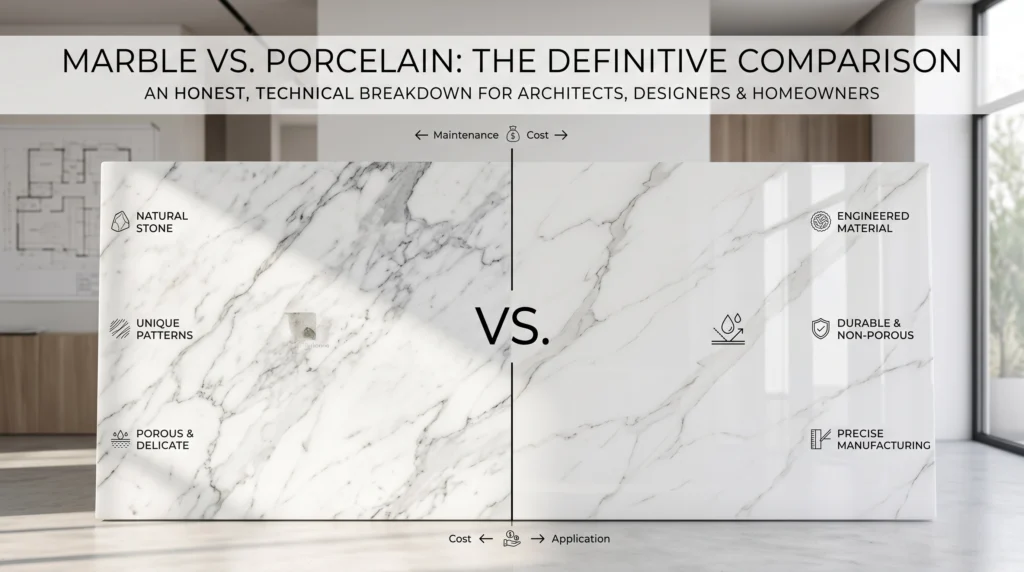
Marble vs. Porcelain: The Definitive Comparison
The debate between marble and porcelain is one of the most common—and most misunderstood—decisions in architecture and interior design. Both materials can achieve breathtaking results. But they behave very differently on the job site, in daily use, and on your budget. This guide cuts through the marketing noise to give you an honest, technical breakdown.
Whether you are an architect specifying a hotel lobby, a designer sourcing a luxury bathroom, or a homeowner renovating a kitchen, the right choice depends on your specific priorities. Let’s compare them across every dimension that matters.
Quick answer:
Choose natural marble for unmatched depth, veining uniqueness, and prestige — accept higher maintenance and cost. Choose porcelain for durability, consistency, and lower long-term upkeep — accept a surface that, however realistic, will never fully replicate the geological soul of stone.
What Is Marble — and What Is Porcelain?
Natural Marble
Marble is a metamorphic rock formed when limestone undergoes extreme heat and pressure deep within the Earth. Its characteristic veining is caused by mineral impurities — iron oxides, clay, and silica — that migrate through the stone during formation. Every slab is geologically unique. Major quarry origins include Carrara, Calacatta, and Statuario in Italy; Thassos in Greece; Crema Marfil in Spain; and Emperador in Morocco.
- Hardness: 3–4 on the Mohs scale
- Water absorption: 0.1–0.5% (varies by variety)
- Typical slab thickness: 2 cm or 3 cm
- Origin: Quarried from natural deposits worldwide
Porcelain Tile
Porcelain is a man-made ceramic product fired at extremely high temperatures (around 1,200–1,400°C) from refined clay, feldspar, and silica. Modern large-format porcelain slabs — sometimes called sintered stone — can reach dimensions of 320 × 160 cm and thicknesses as low as 6 mm. High-definition inkjet printing now allows porcelain to mimic the look of almost any natural stone.
- Hardness: 7–8 on the Mohs scale (much harder than marble)
- Water absorption: < 0.5% (vitrified body; many are near 0%)
- Typical slab thickness: 6 mm–20 mm
- Origin: Manufactured in factories (Italy, Spain, China are major producers)
Marble vs. Porcelain: Side-by-Side Comparison
| Criteria | Natural Marble | Porcelain |
|---|---|---|
| Aesthetics | Unique, living veining; depth and translucency | Consistent pattern; digital print; realistic but repeated |
| Durability | Susceptible to scratching and etching | Highly scratch and wear resistant |
| Maintenance | Requires sealing every 1–2 years; acid-sensitive | Near-zero maintenance; stain and acid resistant |
| Cost (material) | $40–$300+ per sqft (slab, installed) | $5–$80 per sqft (tile, installed) |
| Heat resistance | Moderate; can discolor under sustained heat | Excellent heat resistance |
| Slip resistance | Polished: slippery when wet; honed: safer | Available in R9–R13 anti-slip ratings |
| Weight | ~27 kg/m² at 2 cm | ~14 kg/m² at 6 mm (large format) |
| Resale value | Adds significant premium to property | Neutral to moderate value addition |
| Sustainability | Natural material; quarrying has land impact | Energy-intensive production; long lifespan |
| Best for | Luxury interiors, feature walls, prestige projects | High-traffic areas, wet zones, commercial spaces |
Which to Choose — Room by Room
Kitchen Countertops
This is where the marble vs. porcelain debate is most heated. Marble delivers incomparable beauty — the warmth, the translucency, the veining — but it will etch when it contacts lemon juice, wine, or tomato sauce. If you cook frequently and demand zero maintenance, a large-format porcelain slab countertop (particularly from manufacturers like Dekton, Neolith, or Atlas Concorde) offers near-indestructible performance with convincing marble aesthetics. If you want true marble and accept that it will develop a natural patina over time, choose a honed finish (not polished) and seal it regularly.
Bathroom Floors and Walls
Marble in a bathroom creates an undeniable sense of luxury. For walls and low-traffic floors, it is an excellent choice — provided you select a variety with low water absorption and apply a penetrating sealer. For shower floors, opt for a matte or honed marble with a slip rating of at least R9, or switch to porcelain, which offers superior moisture resistance and anti-slip options. Porcelain is the professional’s choice for high-use hotel bathrooms and spa facilities.
Living Room and Hallway Floors
For large living areas, both materials perform well. Marble elevates the space in a way porcelain cannot fully replicate — the depth of light reflection, the mineral complexity. However, for a hallway with heavy foot traffic, dogs, or children, porcelain’s superior scratch resistance makes it the more practical choice. A compromise increasingly used by designers: marble in the main living area, porcelain in transition zones.
Exterior and Facade
For outdoor applications, porcelain wins decisively. Natural marble is vulnerable to freeze-thaw cycles, acid rain, and UV bleaching. Outdoor-rated porcelain (with low water absorption and appropriate slip ratings) is engineered for these conditions. Some premium marbles — particularly dense varieties like Pietra Serena or certain granites — can be specified outdoors with proper expertise, but the technical risk and maintenance burden are significantly higher.
The Rise of Marble-Look Porcelain: Is It a Viable Alternative?
The sintered stone category has fundamentally changed this debate. Products that digitally replicate Calacatta Gold, Statuario Venato, or Nero Marquina at high resolution are now available in book-matched slab formats that can fool even experienced designers at first glance.
The honest assessment: marble-look porcelain is an excellent product — practical, consistent, and increasingly beautiful. But it is not marble. The surface is a 1–3 mm digital print layer over a uniform body. It lacks the mineral depth, the light transmission, and the geological uniqueness of a natural slab. In a luxury residential project or a five-star hotel, professionals and sophisticated clients will notice the difference. In a commercial office renovation, a rental apartment, or a high-traffic retail environment, marble-look porcelain is often the smarter specification.
True Cost Analysis: Marble vs. Porcelain
Material price is only part of the cost equation. Consider the full lifecycle:
- Marble slab (Calacatta quality): $80–$200/sqft material + $30–$60/sqft fabrication and installation = $110–$260/sqft installed
- Entry marble (commercial grade): $15–$40/sqft material + $15–$30/sqft installation = $30–$70/sqft installed
- Premium porcelain (large format, sintered): $20–$60/sqft material + $15–$25/sqft installation = $35–$85/sqft installed
- Standard porcelain tile: $5–$20/sqft material + $10–$20/sqft installation = $15–$40/sqft installed
Add to the marble equation: annual or biannual sealing ($2–$5/sqft in labor), occasional honing or polishing ($3–$8/sqft if damaged), and potential replacement of etched tiles. Over a 10-year period, a well-maintained marble surface may cost 20–40% more in total ownership than equivalent porcelain.
Use the Stone Moods True Cost Calculator to run your specific project numbers including waste factors, fabrication, and maintenance estimates.
Frequently Asked Questions
Is porcelain tile better than marble for a kitchen?
For a high-use kitchen, porcelain is often the more practical choice because it resists etching from acids (vinegar, citrus, wine), scratching from knives and cookware, and staining from oils and pigments. Natural marble is more vulnerable in cooking environments unless you are prepared to seal it regularly and accept the patina that develops over time. That said, many designers and homeowners choose marble precisely because they love how it evolves — a kitchen with a lived-in Calacatta countertop can be extraordinarily beautiful. The decision depends on how much maintenance you are willing to accept.
Can you tell the difference between marble and marble-look porcelain?
An experienced eye can usually distinguish them. Natural marble has mineral depth — light penetrates slightly into the stone and reflects back, giving it a luminous quality. Porcelain prints sit on the surface and reflect light more flatly. In a slab format, you can also identify porcelain by its perfectly uniform back face and consistent thickness, versus marble’s natural variations. The tile repeat pattern is another giveaway: in a large porcelain installation, the same digital print will eventually repeat, while no two marble slabs are identical. That said, today’s best large-format sintered products are genuinely impressive replications that fool many non-specialists.
Which is better for bathroom floors — marble or porcelain?
For bathroom floors in wet zones like shower trays, porcelain with an R10 or higher slip rating is the safer, more practical specification. For dry bathroom floors and walls, marble is an excellent and beautiful choice — select a honed finish for better slip resistance and apply a penetrating sealer to prevent water ingress. In luxury hotel and spa environments, many designers use a combination: marble on walls for visual impact, porcelain on wet floor areas for safety compliance and durability.
Does marble increase home value more than porcelain?
Yes, in most luxury and mid-to-high-end markets, natural marble commands a higher perceived value and contributes more to property resale prices than porcelain. Real estate agents consistently report that marble bathrooms and kitchens are a selling point that buyers respond to emotionally. Porcelain contributes a clean, updated aesthetic but is less likely to be called out as a premium feature in property listings. The caveat: poorly maintained or etched marble can actually detract from value. Condition matters as much as material.
Still Deciding? Stone Moods Has the Tools.
Our free professional toolkit is built exactly for decisions like this. Run the real numbers on your project, check technical compatibility, and find the stone that matches your design vision.
Related Reading on Stone Moods
- Mastering the Flow: A Guide to Marble Slab Selection and Veining
- Marble vs. Granite: Which Is Better for Your Kitchen Countertop?
- The Architect’s Checklist: What to Verify Before Approving a Marble Slab
- Stone Specification Library