
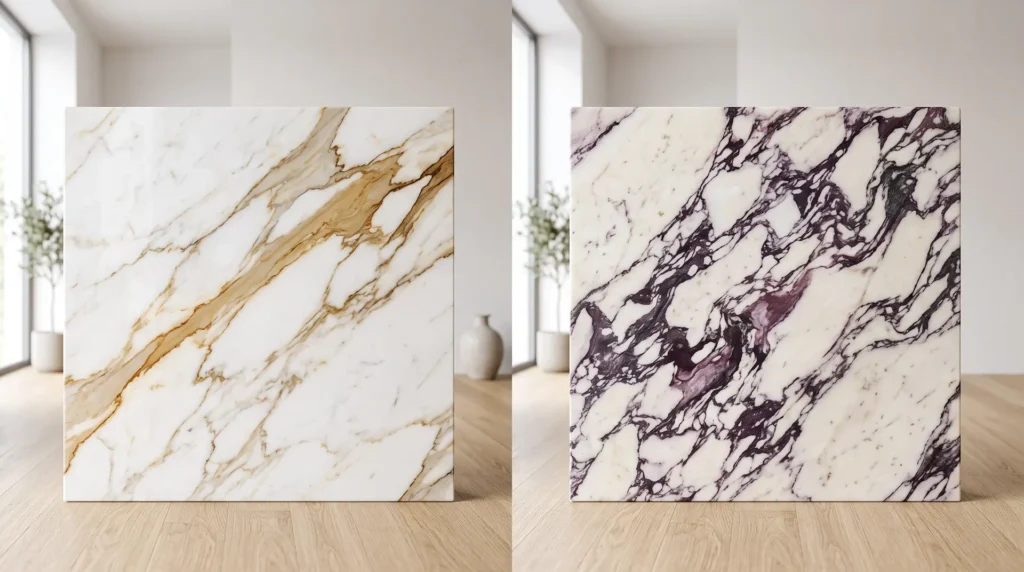
Calacatta Gold vs. Calacatta Viola: Comparing Two Rare Calacatta Varieties
Once you move past standard Calacatta, the naming gets specific fast — and two of the most sought-after variants couldn’t look more different from each other. Calacatta Gold and Calacatta Viola share the same base marble family, but the vein color that runs through each one sends the design in completely opposite directions: one warm and golden, the other dark and unusual.
Both are marketed as premium, statement-grade Calacatta. Neither is common in a standard showroom rotation. This guide breaks down what actually separates them, so you know what you’re specifying — and what you’re paying for.
Quick answer:
Calacatta Gold (often labeled Calacatta Oro) carries warm, golden-to-amber veining against a bright white background — a result of iron oxide deposits in the stone. Calacatta Viola carries dark, violet-to-plum-toned veining, a rarer coloration linked to trace manganese oxide content, and reads as moodier and more unusual. Gold is the more commercially established of the two and easier to source consistently. Viola is rarer, harder to match slab-to-slab, and typically reserved for a single dramatic feature rather than broad use.
Geology: Same Marble Family, Different Trace Minerals
What Is Calacatta Gold?
Calacatta Gold — frequently sold under the name Calacatta Oro — is quarried from the same general Apuan Alps district as standard Calacatta. Its defining feature is veining that carries a warm, golden or amber undertone rather than plain grey. This coloration is generally attributed to iron oxide present in trace amounts within the vein deposits, oxidizing to produce the warm tone. The background remains a bright to slightly warm white, consistent with other Calacatta varieties.
What Is Calacatta Viola?
Calacatta Viola is a considerably rarer variety, characterized by veining that leans violet, plum, or aubergine rather than grey or gold. This unusual coloration is typically attributed to trace manganese oxide content within the vein material — a mineral combination that occurs far less predictably than the iron oxide behind Calacatta Gold’s warmth. Because this specific mineral profile is uncommon, Calacatta Viola is quarried in much smaller, less consistent volumes, and sourcing it reliably is genuinely harder than sourcing Gold.
- Calacatta Gold coloration source: Iron oxide — produces warm gold/amber vein tones
- Calacatta Viola coloration source: Trace manganese oxide — produces violet/plum vein tones
- Key difference: Vein mineral content and resulting color family, not hardness or structure
Calacatta Gold vs. Calacatta Viola: Side-by-Side Comparison
| Property | Calacatta Gold | Calacatta Viola |
|---|---|---|
| Background color | Bright to warm white | White to warm white, occasionally deeper cream |
| Veining character | Bold, warm gold/amber veining | Bold, dark violet-to-plum veining |
| Coloration source | Iron oxide | Trace manganese oxide |
| Mohs hardness | 3–4 | 3–4 |
| Commercial availability | Limited, but established in the market | Very limited — among the rarest Calacatta variants |
| Slab-to-slab consistency | Variable | Highly variable, harder to batch-match |
| Design mood | Warm, luxurious, traditional-leaning | Moody, dramatic, distinctly modern |
| Typical price range | $220–$400+/sqft installed | $280–$500+/sqft installed |
Choosing Based on Design Direction, Not Just Rarity
These two stones don’t really compete for the same project — they tend to get specified for opposite design intents. Calacatta Gold’s warm veining pairs naturally with brass, warm wood tones, and traditional or transitional interiors. It photographs as classically luxurious and reads as an evolution of standard Calacatta rather than a departure from it.
Calacatta Viola is a different proposition entirely. Its dark, unusual veining makes it a genuine conversation piece — the kind of material chosen specifically because it doesn’t look like anything else in the room. It pairs well with matte black fixtures, deep wood tones, or a deliberately minimal, monochrome palette that lets the veining carry all the visual weight.
A sourcing caution: Because Calacatta Viola is genuinely rare, the name occasionally appears on stones with artificially enhanced or dyed veining rather than natural mineral coloration. Ask your supplier directly whether the violet tone is natural or treated — this affects both long-term color stability and how the stone should be sealed and maintained.
Where to Use Each: Application Guide
Kitchen Islands
Calacatta Gold works beautifully as a full-island surface, especially paired with warm cabinetry or brass hardware — its veining feels intentional rather than overwhelming at that scale. Calacatta Viola is almost always better reserved for a smaller surface or a single waterfall panel; its darker, denser veining can visually overwhelm a full island in a way Gold’s lighter warmth does not.
Bathroom Vanities and Feature Walls
Both stones excel here, and this is arguably Viola’s best application — a single bookmatched Viola vanity or shower wall becomes the defining feature of the room. Gold works equally well but leans toward a warmer, more traditional spa aesthetic rather than Viola’s bolder statement. Preview either option with Stone Moods’ Bookmatch Visualizer before finalizing slab selection.
Accent Surfaces
Given the cost and rarity of both — particularly Viola — many designers use these stones sparingly: a powder room vanity, a bar backsplash, a single fireplace surround. This keeps the statement material’s cost contained while still delivering maximum visual impact where it’s seen most.
Cost Comparison: Why Viola Costs More Than Gold
Both are premium-tier Calacatta variants, but Viola’s extreme rarity pushes its typical pricing above Gold’s:
- Calacatta Gold (standard commercial grade): $180–$280/sqft material; $220–$320/sqft installed
- Calacatta Gold (top-tier, strong vein definition): $280–$420+/sqft material; $320–$450+/sqft installed
- Calacatta Viola (available grade): $250–$380/sqft material; $280–$420/sqft installed
- Calacatta Viola (exceptional, verified natural coloration): $380–$550+/sqft material; $420–$600+/sqft installed
Because Viola is harder to source in matched quantities, expect longer lead times and fewer slab options per order compared to Gold. Budget extra time in the project schedule if Viola is the chosen material.
Model your project’s real cost, including waste and fabrication, with the Stone Moods True Cost Calculator.
Frequently Asked Questions
Is Calacatta Viola a real, naturally occurring stone?
Yes, genuine Calacatta Viola exists as a natural marble variant, with its violet vein tones attributed to trace manganese oxide content. However, because it is rare, some stones marketed under the “Viola” name have enhanced or dyed coloration rather than fully natural tones. Verifying with your supplier whether the coloration is natural is worth the conversation, especially at premium pricing.
Which is more durable, Calacatta Gold or Calacatta Viola?
Neither has a durability advantage over the other. Both are calcite marbles with the same hardness (Mohs 3–4) and similar water absorption. The differences between them are entirely about vein color and mineral origin, not performance or longevity.
Can Calacatta Gold or Viola be used outdoors?
Like all calcite marbles, both are better suited to interior applications. Outdoor exposure accelerates etching and dulls polish over time, and the vein colors — particularly Viola’s — may fade or shift with prolonged UV exposure. For exterior stone applications, consult a supplier about more weather-resistant alternatives.
Why is Calacatta Viola so much harder to find than Calacatta Gold?
The mineral conditions that produce violet veining are rarer within the quarry deposits than those producing gold veining, which means fewer blocks naturally exhibit strong Viola coloration. This scarcity is reflected directly in price and lead time — sourcing enough matched Viola slabs for a large project takes considerably more coordination than sourcing Gold.
Specifying Calacatta Gold or Viola for Your Project?
Rare stones deserve careful planning. Check real costs, preview bookmatched veining, and confirm what you’re actually buying before you commit.
Related Reading on Stone Moods
- Calacatta vs. Carrara Marble: The Definitive Comparison
- Statuario vs. Calacatta: The Two Most Prestigious White Marbles Compared
- Dolomite vs. Marble: What’s the Difference and Which Should You Choose?
- Stone Specification Library