
Granite vs. Quartzite: Which Hard Stone Wins for Your Kitchen?
Both of these are genuinely tough, genuinely beautiful natural stones — and both get mislabeled constantly, which is exactly why this comparison matters. Granite and quartzite are two of the hardest, most durable materials available for countertops, and unlike the marble comparisons on this site, this one isn’t about picking the more forgiving option. It’s about picking the right hard stone for the look and performance profile you actually need.
Unlike marble, neither of these is a calcite-based stone — which is exactly why both outperform marble on acid resistance and everyday durability. The real decision between them comes down to formation, appearance, and a few technical differences worth understanding before you buy.
Quick answer:
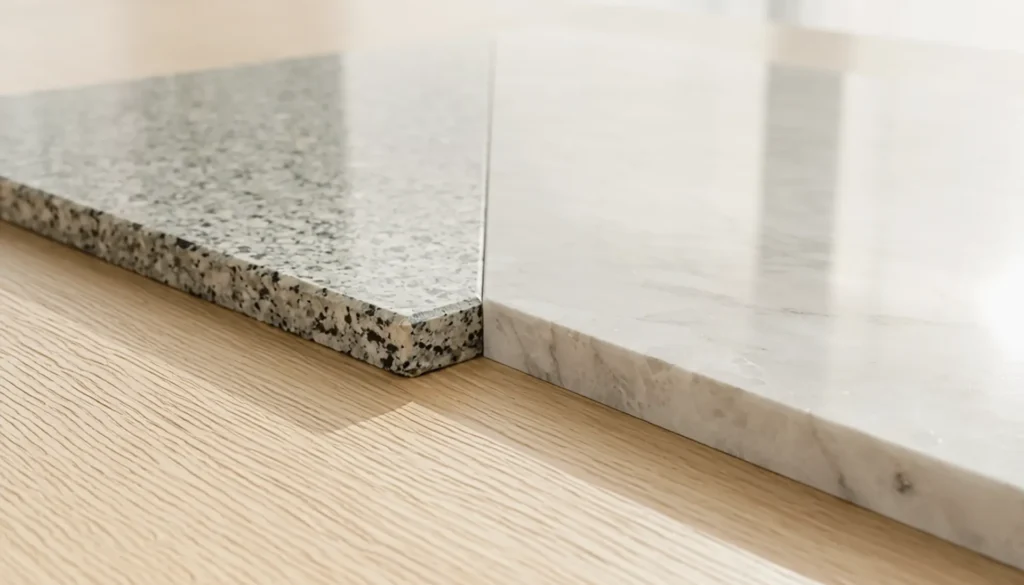
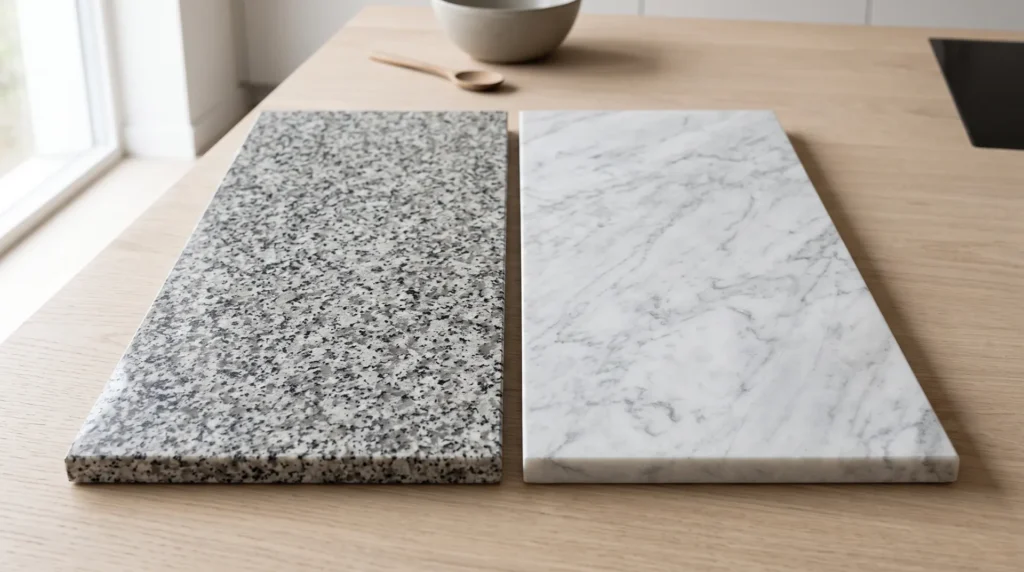
Granite is an igneous rock formed from cooled magma, composed primarily of quartz, feldspar, and mica — giving it a granular, speckled appearance and an enormous range of natural colors. Quartzite is a metamorphic rock formed when sandstone is subjected to intense heat and pressure, recrystallizing into a dense, uniform network of quartz crystals — typically harder than granite, with a more subtle, often marble-like veined appearance. Both resist acid etching far better than marble. Granite offers more color variety and lower cost; quartzite offers superior hardness and a more elegant, marble-adjacent look for buyers who want that aesthetic without marble’s fragility.
Geology: An Igneous Rock vs. a Metamorphic Rock
What Is Granite?
Granite forms deep underground as molten magma cools slowly over thousands of years, allowing large mineral crystals to develop. It is composed primarily of quartz, feldspar, and mica, with the exact mineral ratio determining color and pattern — this is why granite comes in an unusually wide range of colors, from near-black to white, gold, blue, and red. The crystalline structure gives granite its characteristic granular, speckled appearance, quite different from the linear veining seen in marble or quartzite.
What Is Quartzite?
Quartzite begins as sandstone — a sedimentary rock made largely of quartz sand — which is then subjected to intense heat and pressure during metamorphism, fusing the individual sand grains into a dense, interlocking crystalline structure. This transformation is what gives true quartzite its exceptional hardness, often exceeding granite’s. Quartzite’s appearance ranges from granular and granite-like to strikingly veined and marble-like, depending on the original sediment composition and the specific metamorphic conditions.
- Granite formation: Igneous — cooled magma, composed of quartz, feldspar, mica
- Quartzite formation: Metamorphic — sandstone transformed by heat and pressure into fused quartz crystals
- Key difference: Granite is inherently granular and speckled; quartzite can range from granular to dramatically veined depending on its parent sandstone
Granite vs. Quartzite: Side-by-Side Comparison
| Property | Granite | Quartzite |
|---|---|---|
| Rock type | Igneous | Metamorphic |
| Mohs hardness | 6–7 | 7 (often harder than granite) |
| Acid/etch resistance | Excellent | Excellent |
| Heat resistance | Very good | Very good |
| Typical appearance | Granular, speckled, uniform pattern | Granular to dramatically veined, marble-like |
| Color range | Very wide — black, white, gold, blue, red | Narrower — primarily white, grey, tan tones |
| Sealing required | Yes — every 1–2 years | Yes — every 1–2 years |
| Typical price range | $40–$100/sqft installed | $70–$200+/sqft installed |
The Detail That Actually Matters: Not All “Quartzite” Is Real
This is the single most important thing to know before buying quartzite. Because true quartzite has become fashionable specifically for its marble-like veining combined with granite-level durability, the market has a well-documented problem: stones sold as “quartzite” that are actually dolomitic marble — a softer, calcite-adjacent stone that etches from acid almost as easily as true marble does, despite carrying quartzite pricing and marketing.
Genuine quartzite will not etch or dull when tested with a drop of lemon juice or vinegar left for several minutes. If a “quartzite” sample etches under that test, it is very likely a mislabeled dolomitic stone, not true quartzite. This distinction matters enormously — you may be paying quartzite prices for marble-level acid vulnerability.
A verification tip: Before purchasing any stone marketed as quartzite, ask your supplier for a scrap piece and perform a simple acid test at home — a drop of vinegar or lemon juice left for 10 minutes. True quartzite shows no etching. If it etches, you are very likely looking at dolomitic marble sold under a quartzite label.
Where to Use Each: Application Guide
Kitchen Countertops
Both are excellent choices for kitchens specifically because of their acid resistance — this is where granite and quartzite meaningfully outperform marble for everyday cooking use. Granite offers a wider palette if a bold, colorful, speckled look fits the design. Quartzite is the better choice for buyers who want the soft, veined aesthetic of marble without marble’s maintenance anxiety, provided the quarry-verified quartzite is genuine.
Outdoor Kitchens and Patios
Granite is a longstanding favorite for outdoor applications due to its excellent weather and UV resistance, along with its wide color range for matching outdoor design schemes. True quartzite performs comparably well outdoors, though its more limited color range and higher cost make granite the more common practical choice for large outdoor installations.
Flooring
Both stones handle high foot traffic well given their hardness, though granite’s lower cost typically makes it the more practical choice for large flooring areas. Quartzite flooring appears in premium residential and hospitality projects where its marble-adjacent look is specifically desired.
Feature Walls
Quartzite with strong veining character can serve as a striking, durable alternative to marble for a bookmatched feature wall — delivering a similar visual drama with significantly better everyday resilience. Use Stone Moods’ Bookmatch Visualizer to preview how a veined quartzite slab pair will mirror before fabrication.
Cost Comparison
- Granite (standard commercial grade): $30–$60/sqft material; $40–$80/sqft installed
- Granite (premium, exotic colors): $70–$120/sqft material; $90–$150/sqft installed
- Quartzite (standard, granular type): $50–$90/sqft material; $70–$120/sqft installed
- Quartzite (premium, strongly veined, marble-adjacent): $120–$250+/sqft material; $150–$280+/sqft installed
The price gap widens considerably for quartzite varieties with dramatic, marble-like veining, since these are rarer and harder to quarry consistently than either standard granite or granular quartzite.
Run your exact project numbers with the Stone Moods True Cost Calculator.
Frequently Asked Questions
Is quartzite harder than granite?
Generally, yes. True quartzite typically registers around Mohs 7, at or slightly above granite’s 6–7 range, due to its dense, fused quartz crystal structure. In practical terms, both are excellent, highly durable choices — the hardness difference rarely matters for everyday countertop use, but it does make quartzite marginally more scratch-resistant.
Why is quartzite more expensive than granite?
Quartzite, particularly the strongly veined, marble-like varieties, is quarried in smaller volumes than granite and requires more selective sourcing to achieve consistent slab-to-slab appearance. Granite’s abundance and enormous color variety keep its average pricing lower across the board.
How do I know if I’m actually buying real quartzite?
Perform a simple acid test on a sample piece — a drop of lemon juice or vinegar left for about 10 minutes. True quartzite will show no etching or dulling. If the surface etches, it is very likely dolomitic marble mislabeled as quartzite, a common and well-documented issue in the stone trade.
Which is better for a busy family kitchen?
Both perform well, but granite’s lower cost and wider color selection often make it the more practical choice for high-use family kitchens where budget and easy color matching matter. Quartzite is the better choice if a marble-like aesthetic is a non-negotiable design requirement and the budget supports it.
Choosing Between Granite and Quartzite for Your Project?
Compare real installed costs and preview veined slab bookmatching before you commit to either stone.
Related Reading on Stone Moods
- Calacatta vs. Carrara Marble: The Definitive Comparison
- Marble vs. Porcelain: Which Is Right for Your Project?
- Dolomite vs. Marble: What’s the Difference and Which Should You Choose?
- Stone Specification Library