
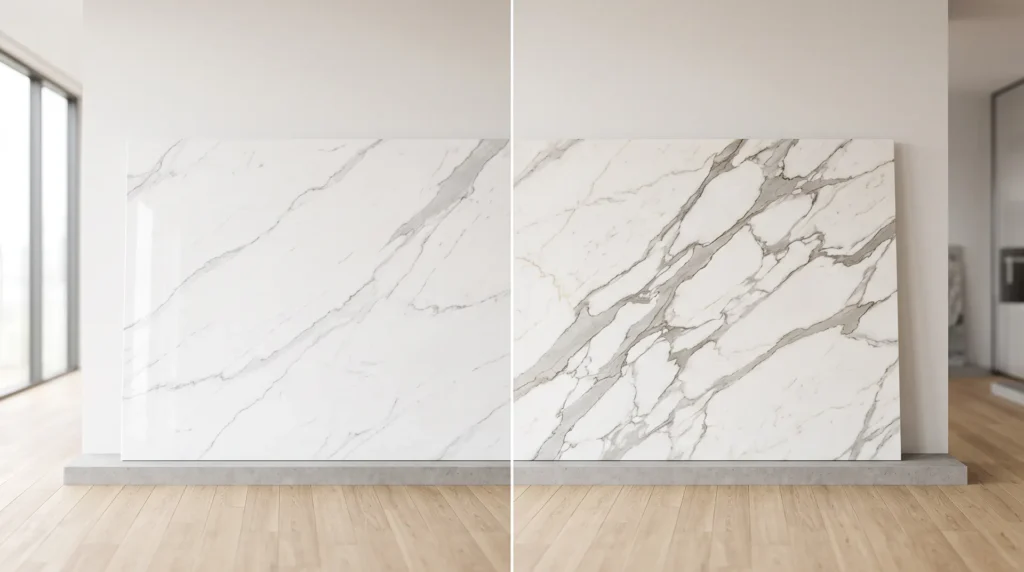
Statuario vs. Calacatta: The Two Most Prestigious White Marbles Compared
These are the two marbles that sit at the very top of the price ladder — and the two that get confused for each other most often, even by people who work with stone every day. Both are quarried from the same corner of Tuscany. Both are prized for a bright white background. And both can carry price tags that make Carrara look like a budget material. But they are not interchangeable, and understanding the difference matters when you are paying premium-tier prices.
If you already know how Calacatta compares to standard Carrara, this comparison goes a level higher — into the distinction between Calacatta and the marble many consider the single finest white stone in the world: Statuario.
Quick answer:
Statuario has the purest, most uniform bright-white background of any commercial marble, with linear, flowing, relatively restrained grey veining and a subtle translucency prized since the Renaissance for sculpture. Calacatta’s background runs slightly warmer, and its veining is bolder, thicker, and more chaotic — sometimes with a gold undertone. Statuario tends to command the highest price of the two, largely due to its extreme rarity and the near-total absence of impurities required to achieve that pure white base.
Geology: Two Marbles From the Same Corner of Italy
What Is Statuario Marble?
Statuario is quarried from a small number of sites within the greater Carrara district of the Apuan Alps — historically the most selective quarries in the region, reserved for blocks with the fewest visible impurities. The name itself comes from “statuario,” Italian for “fit for statues” — this is the marble Michelangelo favored for sculptural work, prized for its near-total absence of grey mottling and its subtle translucency, which allows light to penetrate slightly beneath the surface. Like all marbles in this family, it is composed of calcite (CaCO₃), but with an unusually low concentration of the mineral impurities that typically introduce background discoloration.
What Is Calacatta Marble?
Calacatta is also quarried from the Apuan Alps, from a distinct set of quarries near Fantiscritti and Crestola. It shares Statuario’s calcite base but carries a different impurity profile — one that produces a background with slightly more warmth and, critically, veining that is bolder, thicker, and more irregular than Statuario’s. Where Statuario’s veins tend to flow in long, relatively continuous lines, Calacatta’s veins branch, thicken, and sometimes carry a gold or beige undertone (most pronounced in varieties like Calacatta Oro).
- Statuario composition: Calcite (CaCO₃) — exceptionally low impurity content, high uniformity
- Calacatta composition: Calcite (CaCO₃) — moderate impurity content, produces warmer tone and bolder veining
- Key difference: Background purity and vein behavior, not hardness or chemical structure
Statuario vs. Calacatta: Side-by-Side Comparison
| Property | Statuario Marble | Calacatta Marble |
|---|---|---|
| Background color | Pure, uniform bright white | White with a warmer, sometimes creamy undertone |
| Veining character | Linear, flowing, relatively restrained | Bold, thick, branching, irregular |
| Vein color | Grey, occasionally with soft gold flecks | Grey and/or pronounced gold (Calacatta Oro) |
| Translucency | Higher — subtle light penetration | Moderate |
| Mohs hardness | 3–4 | 3–4 |
| Quarry yield | Extremely limited | Limited, but more available than Statuario |
| Slab-to-slab consistency | Moderate — background stays uniform, vein position varies | Highly variable |
| Historical use | Renaissance sculpture, Michelangelo’s works | Primarily architectural and interior use |
| Typical price range | $250–$500+/sqft installed | $150–$450+/sqft installed |
Telling Them Apart: What to Actually Look For
In photographs, Statuario and Calacatta can look nearly identical — both are dramatic white marbles with bold grey veining, and marketing materials frequently blur the line further by using both names loosely. In person, the differences are more apparent.
Statuario’s background holds a stark, almost stark-white consistency across the entire slab, with minimal color variation. The veining, while dramatic, tends to run in more predictable, elongated paths — think of long grey rivers rather than scattered branches. This restraint is exactly what made it the preferred stone for sculpture: sculptors needed a background free of unpredictable mineral deposits that could compromise a carved surface.
Calacatta’s background, by contrast, often carries a faint warmth — sometimes described as ivory or cream rather than stark white — and the veining is noticeably bolder and more chaotic. Calacatta Oro in particular introduces visible gold tones into the veins, something true Statuario rarely exhibits. If a slab marketed as “Statuario” shows heavy gold veining or a distinctly warm background, it is very likely Calacatta or a Calacatta-Statuario hybrid rather than true Statuario.
A naming caution: “Statuario” is sometimes applied loosely to any bright-white, bold-veined marble — including some Calacatta varieties and even certain Chinese or Turkish white marbles quarried far from Carrara. If quarry origin and authenticity matter for your project (and at this price point, it should), request documentation confirming the specific quarry.
Where to Use Each: Application Guide
Kitchen Islands and Waterfall Edges
Both are frequently reserved for a single showpiece surface rather than full-kitchen coverage, given the cost. Statuario’s more restrained, flowing veining tends to read as quietly luxurious on a waterfall island, while Calacatta’s boldness makes a louder visual statement. Neither offers a durability advantage over the other — the choice here is entirely aesthetic.
Bathroom Feature Walls
This is arguably where both stones are used to greatest effect. A bookmatched Statuario wall behind a freestanding tub delivers a serene, almost sculptural quality consistent with its historical use. Calacatta in the same application reads as more dramatic and ornate. Preview either option using Stone Moods’ Bookmatch Visualizer before committing — at this price tier, seeing the mirrored veining in advance is essential.
Sculptural and Custom Millwork
For custom fabricated pieces — sculptural vanities, freestanding tub surrounds, carved elements — Statuario’s superior translucency and lower impurity content remain relevant even today, echoing its historical use. Calacatta is rarely specified for genuinely sculptural work for this reason, though it excels in flat architectural applications.
Cost Comparison: Why These Are the Most Expensive Marbles
Both stones sit at the top of the market, and pricing depends heavily on the specific quarry, block, and grade:
- Calacatta (mid-grade, quarry-verified): $150–$250/sqft material; $180–$280/sqft installed
- Calacatta (top-tier, e.g. Calacatta Oro): $250–$450+/sqft material; $300–$500+/sqft installed
- Statuario (standard grade): $200–$350/sqft material; $250–$400/sqft installed
- Statuario (exceptional, low-impurity blocks): $350–$600+/sqft material; $400–$650+/sqft installed
At the very highest grades, true Statuario often exceeds even top-tier Calacatta, driven almost entirely by the extreme scarcity of blocks pure enough to meet the historical “statuario” standard. Bookmatched installations in either stone add a meaningful premium for slab matching and layout, given how few consecutive slabs share compatible veining.
Model your project’s real cost — including bookmatching waste, fabrication, and edge details — with the Stone Moods True Cost Calculator.
Frequently Asked Questions
Is Statuario more expensive than Calacatta?
At the highest grades, yes — true, low-impurity Statuario often commands the highest price of any commercially available marble, exceeding even top-tier Calacatta. This is driven by extreme scarcity: the pure white, low-mottling blocks required to meet the historical statuario standard are quarried in very small volumes. That said, entry-grade Calacatta and entry-grade Statuario can overlap in price, so the specific grade matters more than the name alone.
Is Statuario harder or more durable than Calacatta?
No. Both are calcite marbles with essentially identical hardness (Mohs 3–4) and water absorption. Neither offers a durability or maintenance advantage — the price and desirability differences are entirely about rarity and appearance, not performance.
How can I tell if a slab labeled “Statuario” is genuine?
Look closely at background tone and vein character. True Statuario has a stark, uniform white background with restrained, flowing grey veins and minimal warmth. If the slab shows a creamy or ivory background, heavy gold veining, or chaotic branching patterns, it is more likely Calacatta or a stone marketed loosely under the Statuario name. Requesting quarry documentation is the only reliable way to confirm origin at this price point.
Which is better for a bookmatched feature wall?
Both work beautifully, and the decision comes down to desired mood. Statuario’s more linear, restrained veining creates a calmer, more sculptural bookmatch effect. Calacatta’s bolder, more irregular veining produces a more dramatic, ornate mirrored pattern. Because both are extremely limited in supply, sourcing two consecutive slabs with strong bookmatch potential should be confirmed with your fabricator before finalizing the design.
Specifying Statuario or Calacatta for Your Project?
At this price tier, verifying the slab and previewing the result before fabrication isn’t optional — it’s essential. Stone Moods’ toolkit is built for exactly this.
Related Reading on Stone Moods
- Calacatta vs. Carrara Marble: The Definitive Comparison
- Dolomite vs. Marble: What’s the Difference and Which Should You Choose?
- Marble vs. Porcelain: Which Is Right for Your Project?
- Stone Specification Library