
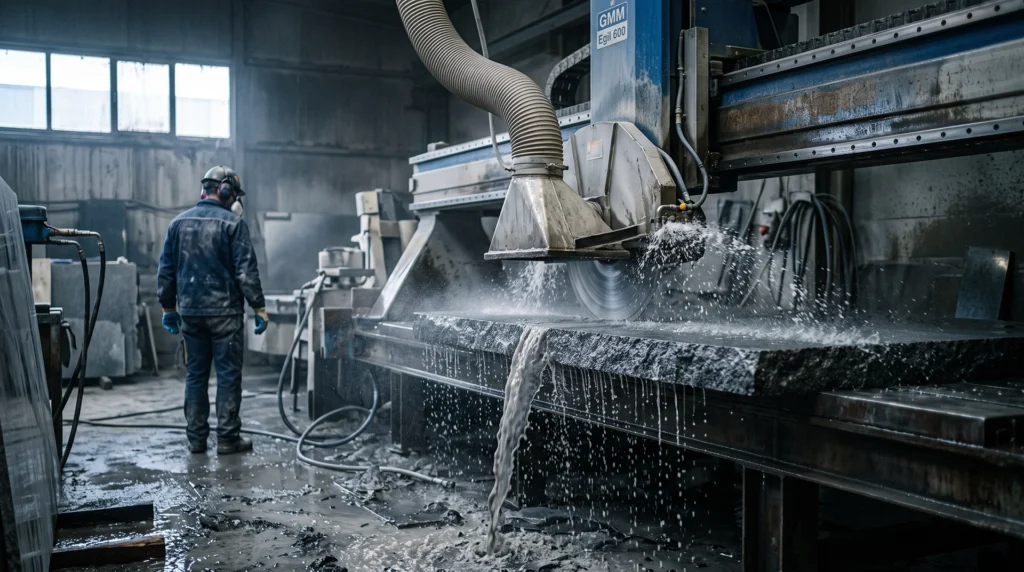
Every few months another country, state or regulator cracks down on silica, and buyers keep asking the same question: does this affect the stone I’m about to specify? The honest answer is yes, but not equally. Respirable crystalline silica (RCS) is a dust hazard created when stone is cut, ground, routed or polished. A finished surface sitting in your kitchen does not create it. The rules are written for the workshop, yet they are already reshaping which materials stay available, how fabricators price jobs, and what a careful buyer should ask before signing.
1. Not All Stone Carries the Same Silica Load
- Engineered quartz: the highest-risk category. Slabs can exceed 90% crystalline silica bound in resin. Some manufacturers now sell lower-silica lines (maximums of roughly 10–40%), and a few recycled-glass-and-cement composites measure under 0.2%.
- Quartzite: natural, but built almost entirely from fused quartz. For dust purposes it belongs with the high-silica group (see our Granite vs. Quartzite breakdown).
- Granite: typically 10–45% silica, with some varieties reaching about 50% according to OSHA and NIOSH. “Natural” does not mean “low-silica.”
- Marble, limestone and travertine: calcite-based stones. Marble typically sits under 5% silica, and limestone and travertine are similarly low. Always confirm per quarry and variety.
- Verdict: silica risk follows mineralogy, not marketing. Engineered quartz and quartzite sit at the top, granite in the middle, and the calcite family at the bottom.
2. The Rulebook: What’s Law, What’s Proposed
- United States (federal): OSHA’s limit is 50 µg/m³ averaged over an 8-hour shift, with an action level of 25 µg/m³. Employers must use engineering controls such as water and ventilation first and respirators only when those fall short. They also need a written exposure control plan, worker training and medical exams for highly exposed workers.
- European Union: a binding limit of 0.1 mg/m³ for respirable crystalline silica from work processes (Directive 2017/2398).
- Australia: engineered stone benchtops, panels and slabs have been banned since 1 July 2024, after Safe Work Australia could not identify a safe level of silica in engineered stone. Natural stone is not covered by that ban.
- California: a permanent silica standard adopted in early 2025 adds stricter rules for artificial stone and for natural stone above 10% crystalline silica. On 21 May 2026 the state’s Standards Board voted unanimously to start emergency rulemaking toward banning the fabrication and installation of artificial stone above 1% crystalline silica. A draft rule followed on 16 September 2026. At the time of writing we have not confirmed a final adoption vote, so check current status before relying on it. State health officials have recorded more than 560 engineered-stone silicosis cases and 31 deaths since 2019.
- Verdict: the sharpest regulatory pressure targets engineered stone, but exposure limits apply to every silica-bearing material. Fabrication practice matters as much as the label on the slab.
3. What It Means for Your Specification
- Get silica content in writing: engineered stone manufacturers publish it in safety data sheets. For natural stone, ask the supplier for the safety data sheet or a mineralogical statement for that variety.
- Ask the fabricator how they control dust: wet cutting, on-tool water, extraction, a written exposure control plan, a trained crew. A shop that cannot answer is a schedule risk as well as a health risk, and Cal/OSHA alone has issued more than 900 citations in its silica enforcement program.
- Be skeptical of “low-silica” claims: lower is not the same as safe. California’s draft uses a 1% threshold, and Australian regulators concluded that no safe silica level could be identified for engineered stone.
- Plan for supply shocks: as summarized by legal commentators, California’s draft would stop fabricators acquiring new above-threshold slabs about 60 days after the rule takes effect. That is a tight window for a project already in specification.
- Verdict: choose the stone for the design, then vet the shop for the dust.
4. Cost Analysis
| Cost / Risk Factor | Engineered Quartz | Granite & Quartzite | Marble, Limestone & Travertine |
|---|---|---|---|
| Crystalline silica content | Very high (can exceed 90%) | High (granite ~10–50%; quartzite higher) | Low (marble typically under 5%) |
| Shop dust-control burden | Highest | High | Lower on the silica side |
| Regulatory trajectory | Tightening (bans in force or proposed) | Covered by general silica limits | Rarely the regulatory focus |
| Compliance cost reaching the buyer | Upward pressure likely | Moderate | Low |
| Supply / lead-time risk | Elevated where bans are proposed | Stable | Stable |
These ratings are directional, not quoted prices. They show where compliance cost pressure is most likely to land.
Fabricator’s Investment: wet-cutting systems, dust extraction and filtration, and an initial exposure assessment through air sampling.
Running Costs: filter maintenance, ongoing exposure monitoring, worker training and medical surveillance for staff above the action level. These recurring costs are the part that quietly reaches your quote.
(Conclusion) Silica rules are not a reason to avoid natural stone. They are a reason to ask better questions. Engineered quartz faces the sharpest regulatory headwind. Granite and quartzite remain fully workable but demand disciplined fabrication. Marble, limestone and travertine sit at the low end of silica risk. In every case, the safest and most predictable project is the one where the fabricator can show how they control dust.
Industry Insight: expect silica content and dust-control practice to start appearing in tender documents and specification packs, the way fire ratings and slip resistance already do. Quarries and exporters who can supply a clear mineralogical statement with each shipment, and fabricators who can show their exposure control plan, will clear approvals faster than those who cannot. To check materials against your project, use our Material Validator, and see how the main surface categories compare in Marble vs. Quartz 2026. For how cutting methods differ, read CNC Waterjet vs. Bridge Saw.
Specifying stone for a project with compliance questions?
Tell us your stone, your market and your fabrication route, and we will point you to the right questions to ask before you sign. Send your details below and we will get back to you.
This article is for general information only and is not legal or health advice.