
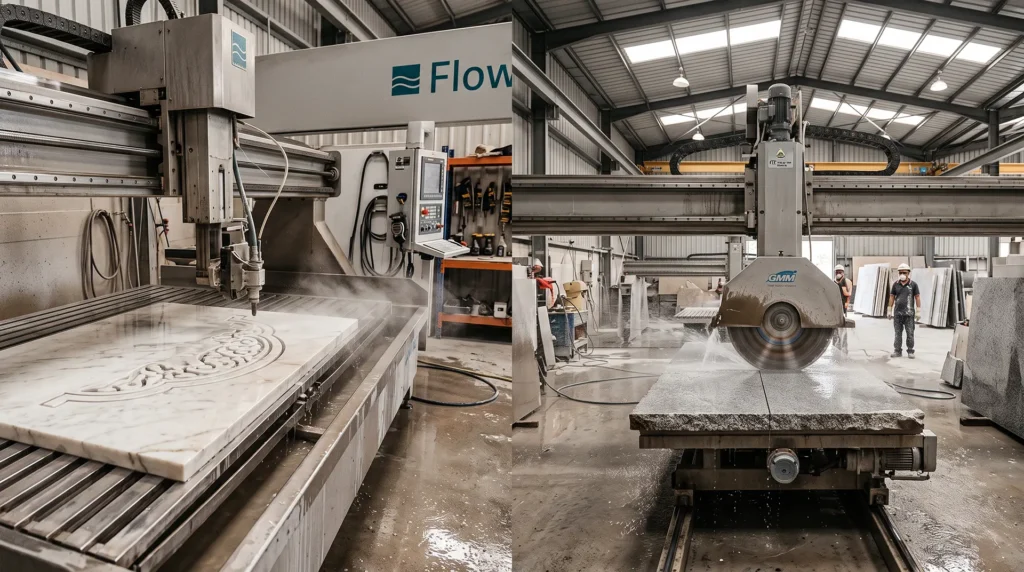
CNC Waterjet vs. Bridge Saw: Which Cutting Method Fits Your Project?
For a straight-edge countertop, the bridge saw has never really been challenged — it’s fast, mechanically simple, and it’s what most fabrication shops built their throughput around. But the moment a project calls for a curved edge, an inlay, a sink cutout with tight interior corners, or a medallion pattern, the bridge saw hits a hard physical limit. This is where CNC Waterjet technology takes over. Neither machine is obsolete — they solve different problems, and most serious fabrication shops now run both side by side.
1. Cutting Geometry & Design Freedom
- CNC Waterjet: A multi-axis nozzle traces virtually any 2D shape — curves, medallions, inlays, custom sink cutouts, even lettering. It is closer to a printer for stone than a saw.
- Bridge Saw: Limited by the physical radius of a circular diamond blade. Straight lines and shallow miters are its strength, but tight interior curves are physically impossible without leaving “dog-bone” notches at the corners that require separate hand-grinding.
- Verdict: If the design calls for anything beyond a straight or gently mitered edge, waterjet is not the better option — it’s the only option.
2. Speed for Standard Cuts
- Bridge Saw: Extremely fast for straight rip cuts and slab-to-size mitering. This is still the daily workhorse for cutting volume in most shops.
- CNC Waterjet: Noticeably slower per linear foot on simple straight cuts — pierce time and abrasive flow rate cap the feed speed in a way a spinning blade doesn’t.
- Verdict: For high-volume production of standard straight-edge countertops, the bridge saw wins on raw throughput every time.
3. Material Stress & Edge Quality
- CNC Waterjet: A genuinely cold cutting process — no frictional heat is generated, which means essentially zero risk of thermal micro-fracturing. This matters most on fragile or heavily fissured material like backlit onyx or highly veined marble.
- Bridge Saw: The diamond blade generates real frictional heat. Water cooling manages most of it, but on brittle or already-fissured stone, heat stress along the cut line can quietly propagate hairline cracks that only show up later.
- Verdict: For premium, fragile, or fissure-prone slabs — the material where a cracked corner means a five-figure loss — waterjet’s cold cut is the safer call, even at the cost of speed.
4. Cost Analysis
| Cost Factor | CNC Waterjet | Bridge Saw |
|---|---|---|
| Initial Investment (CapEx) | Very High (pump system, gantry, precision control) | Moderate (mature, widely available new and used market) |
| Consumables Cost | High (abrasive garnet, nozzle and orifice wear, pump seals) | Low-Moderate (diamond blade wear, water) |
| Cutting Speed — Straight Lines | Slower | Faster |
| Cutting Speed — Curves/Inlay | Only method capable of this work | Not physically possible |
| Thermal Stress Risk | None (cold cutting) | Present — manageable with proper cooling |
| Maintenance | Complex — high-pressure pump and abrasive feed system | Simpler mechanical maintenance |
Initial Investment: Waterjet systems typically carry a significantly higher upfront cost than a comparable bridge saw, driven by the high-pressure pump and precision motion control required.
Running Costs: Bridge saws win on consumables — diamond blades are far cheaper per slab than the garnet abrasive a waterjet consumes continuously during a cut. But waterjet’s cold-cutting process avoids the scrap and rework cost of a cracked premium slab, which can offset the higher running cost on high-value material.
(Conclusion) Neither machine makes the other obsolete. The bridge saw remains the fastest, cheapest way to cut standard straight-edge slabs at volume. The CNC waterjet earns its cost on the work a bridge saw simply cannot do: curves, inlays, medallions, and fragile or fissure-prone premium stone where a cold cut is worth the extra time.
Industry Insight: Most high-end fabrication shops now run a hybrid workflow — the bridge saw rough-cuts the slab down to near-final dimensions, and the CNC waterjet is reserved only for the finishing details: sink cutouts, curved edges, or inlay work. This limits the waterjet’s slower cut time to exactly the work that actually needs its precision, rather than running the whole slab through it.
For a related look at how the block itself gets cut down before it ever reaches the saw or waterjet, see our comparison of Gang Saw vs. Multi-Wire block-cutting technology.
Planning a Cutting Technology Investment for Your Fabrication Shop?
Choosing between waterjet and bridge saw technology directly impacts what kinds of projects your shop can take on, and at what margin. Our industry consultants help you match the right cutting technology to your actual project mix.