
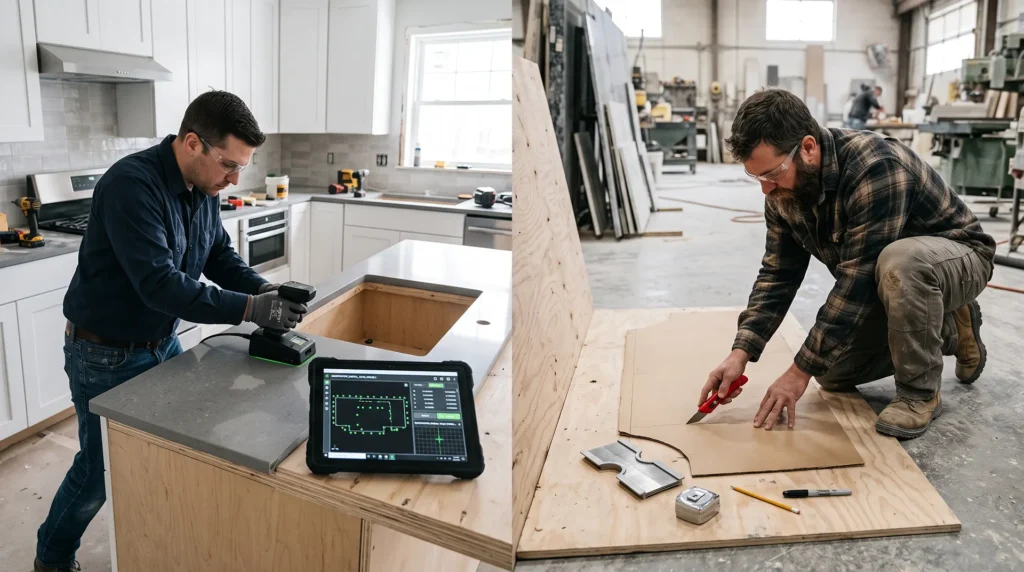
Digital Templating vs. Manual Templating: Which Measurement Method Wins?
Every stone fabrication job starts the same way: someone has to capture the exact shape of the space before a single cut is made. For decades that meant a fabricator on-site with a roll of luan board, a contour gauge, and a hot glue gun, building a physical template piece by piece. Today, a growing share of shops walk in with a laser device instead and walk out with a finished digital file. Both approaches still produce a working template — the question is which one actually earns its cost for your shop’s volume and job mix.
1. Accuracy & Error Margin
- Digital Templating: Laser-based systems capture reference points to within roughly a millimeter, recording exact angles, out-of-square walls, and curves without relying on a human eye or a tape measure’s stretch.
- Manual Templating: Accuracy depends entirely on the fabricator’s measuring technique. Cardboard or luan templates are also physically vulnerable — humidity, temperature swings, and rough handling during transport can warp a template just enough to throw off a cut line.
- Verdict: For complex layouts — waterfall edges, multiple seams, irregular walls — digital templating’s precision meaningfully reduces the risk of a costly miscut.
2. Speed & Workflow
- Digital Templating: On-site capture typically takes minutes, and the data goes directly into CAM or nesting software — no second in-shop layout step required.
- Manual Templating: Requires building the physical template on-site, transporting it intact back to the shop, and then manually laying it on the slab to plan the cut — three distinct steps where a digital workflow needs one.
- Verdict: Digital templating removes an entire handoff from the process, which compounds into real scheduling advantages on high-volume weeks.
3. Material Waste & Slab Yield
- Digital Templating: Digital point data feeds directly into slab-nesting software, which can optimize the layout across a slab’s actual veining and dimensions to minimize offcuts.
- Manual Templating: Layout is done by eye, laying the physical template directly on the slab. This works fine for simple rectangular jobs but leaves more slab utilization on the table for complex, multi-piece layouts.
- Verdict: For premium slabs where yield directly affects margin, digital templating’s software-optimized nesting can pay for itself over enough jobs.
4. Cost Analysis
| Cost Factor | Digital Templating | Manual Templating |
|---|---|---|
| Initial Investment (CapEx) | High (laser device, software license, training) | Low (luan board, contour gauges, basic tools) |
| Per-Job Labor Time | Lower — single site visit, direct digital handoff | Higher — template build, transport, and shop layout |
| Slab Yield / Waste | Better — software-optimized nesting | Adequate for simple jobs; less optimized for complex layouts |
| Rework / Error Risk | Low | Moderate — transport and measurement error possible |
| Best Fit | High-volume shops, complex or multi-seam layouts | Low-volume shops, simple rectangular jobs |
Initial Investment: Digital templating systems carry a real up-front cost — the device itself plus a software subscription in most cases — that a small shop doing a handful of simple jobs a week may not recover quickly.
Running Costs: Manual templating’s material costs are close to negligible. Digital templating’s advantage shows up instead in labor hours saved and waste reduced per job, which only accumulates into real savings at sufficient volume.
(Conclusion) Manual templating remains a perfectly viable method for a low-volume shop doing straightforward, mostly rectangular work — the tooling cost of going digital simply isn’t justified at that scale. Digital templating earns its cost specifically at higher volume or with complex, multi-seam, tightly-curved layouts, where its accuracy and nesting efficiency compound into real time and material savings.
Industry Insight: Many shops that adopt digital templating find its biggest advantage isn’t measurement at all — it’s the ability to feed the captured digital file directly into slab-matching software, letting the customer preview exactly where a slab’s veining will land on their finished countertop before a single cut is made. That sales and approval advantage often matters as much to a shop’s bottom line as the waste reduction does.
For more on how fabrication technology choices affect cost and output, see our comparisons of Gang Saw vs. Multi-Wire block-cutting technology and CNC Waterjet vs. Bridge Saw cutting methods.
Planning a Templating System Upgrade for Your Shop?
The right measurement method depends on your job mix, volume, and the complexity of the layouts you typically fabricate. Our industry consultants can help you weigh the investment against your actual workload.