
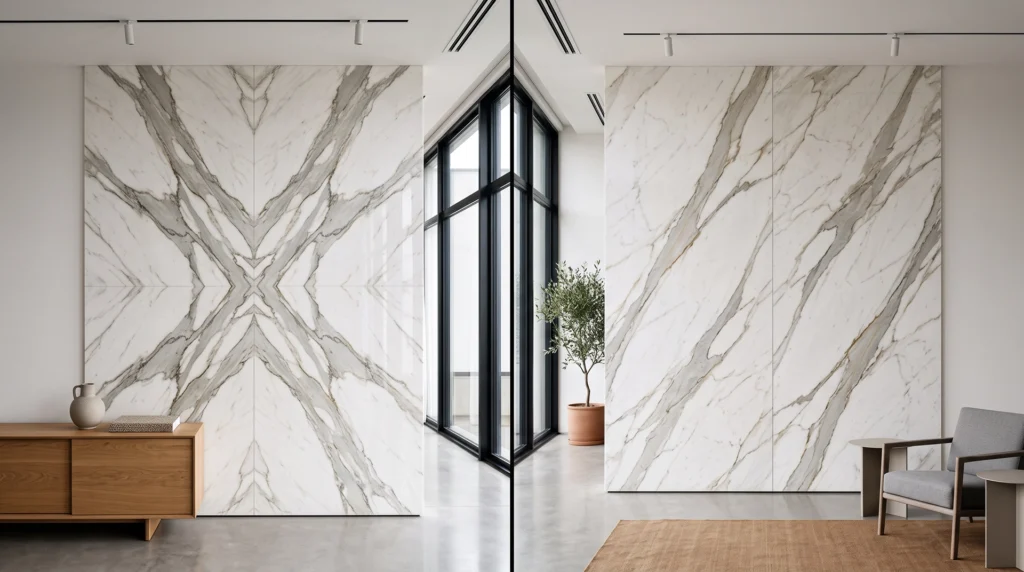
Bookmatch vs. Slip Match: Which Slab Layout Should You Specify?
Two slabs cut from the same block can be installed side by side in two very different ways, and the choice changes how the whole wall, island, or floor reads. Bookmatch flips the second slab like the page of an open book, creating a mirror image at the joint. Slip match slides the slabs along in sequence without flipping, so the pattern repeats in the same direction. One is a statement; the other is a rhythm.
This is a layout decision, not a stone decision: both methods apply to the same material. Unlike our stone-vs-stone comparisons, the question here is how consecutive slabs relate to each other once they are cut, polished, and set, and what that costs you in material, tolerance, and risk.
Quick answer:
Bookmatching takes two (or more) consecutive slabs from the same block, mirrors one against the other at the shared edge, and produces a symmetrical, butterfly-like pattern at the joint. Slip matching lays consecutive slabs side by side in their original orientation, so the veining continues in the same direction but does not mirror. Choose bookmatch for dramatic, strongly veined stones on feature walls and islands where symmetry is the point and the budget allows extra material. Choose slip match for linear or evenly patterned stones, long runs, and projects where a calm, continuous flow matters more than a mirrored focal point.
How Each Match Actually Works
What Is a Bookmatch?
When a block is sawn into slabs, each cut exposes two mirror-image surfaces: the face of one slab and the back of the next. Bookmatching takes two consecutive slabs, opens them like a book, and joins them at one edge. The vein pattern on the left is a reflection of the pattern on the right, which creates the symmetrical “butterfly” at the seam. Add two more slabs mirrored across the other axis and you get a four-way or diamond match.
What Is a Slip Match?
Slip matching uses the same consecutive slabs but does not flip them. They are simply slid along each other in sequence, so the pattern keeps travelling in the same direction. The veins appear to continue across the joint, but because the slabs are not mirrored, the lines will not meet perfectly at the seam; there is a visible shift where one slab ends and the next begins.
- Bookmatch: Consecutive slabs, one flipped; mirror-image pattern at the joint
- Slip match: Consecutive slabs, none flipped; same-direction pattern with a shift at the joint
- Key difference: Bookmatch creates symmetry at the seam; slip match creates continuity along the run
Bookmatch vs. Slip Match: Side-by-Side Comparison
| Property | Bookmatch | Slip Match |
|---|---|---|
| Pattern at the joint | Mirror image, symmetrical | Same direction, shifted |
| Visual effect | Dramatic, formal, focal-point | Calm, rhythmic, continuous |
| Best stone types | Strongly veined or patterned (marble, quartzite, onyx) | Linear or evenly banded stones (vein-cut travertine, many limestones) |
| Slab requirement | Consecutive slabs from the same block, kept in sequence | Consecutive slabs preferred, but more forgiving |
| Material waste | Higher, since slab orientation and vein alignment limit layout options | Lower, more flexible layout |
| Tolerance for slab variation | Low; thickness or cut differences show at the seam | Higher; the shift hides small mismatches |
| Fabrication complexity | High; precise alignment and tight joint | Moderate |
| Typical use | Feature walls, islands, vanity backsplashes, lobby walls | Long walls, floors, wide countertops, facades |
The Real Difference: Symmetry vs. Continuity
Most people choose between these two on looks alone, but the stone itself often decides. Bookmatching only pays off when the pattern has enough character to mirror. A pale, evenly textured stone bookmatches into… a pale, evenly textured stone, and you have paid for symmetry nobody can see. A stone with bold, directional veining turns the same joint into the entire design.
Slip match solves the opposite problem. Linear stones, such as vein-cut travertine with its long horizontal bands, look best when the lines appear to run on from slab to slab. Mirroring them would create an odd “V” at the seam and break the horizontal calm that made the stone attractive in the first place.
The hidden variable is the slab supply. Both methods look best with consecutive slabs, and a bookmatch requires them. If the slabs you are shown are not numbered in sequence from the same block, a true bookmatch is not possible, no matter what the supplier calls it.
A naming caution: “Bookmatched” is used loosely in the trade. Check that the slabs carry sequential bundle numbers from the same block and ask for photos of the actual pair laid together, not a catalog image. Also note that large-format porcelain and sintered stone can be sold as “bookmatched” by printing a mirrored pattern. That is a decorative print, not a natural mirror image, and it behaves very differently at the edges and in repair.
Where to Use Each: Application Guide
Feature Walls and Shower Surrounds
Bookmatch is the natural choice where a wall is the room’s focal point, particularly with strongly veined marble or quartzite. Keep in mind that a bookmatched wall is only as good as its weakest slab: any chip or breakage during transport means the replacement must come from the same block, in sequence.
Kitchen Islands and Waterfall Edges
Bookmatched islands, including waterfall ends where the pattern appears to flow over the edge, are a staple of high-end kitchens; see our article on monolithic kitchen islands for the broader design trend. Slip match works well when the island is long and the veining is consistent, because it keeps the pattern uniform along the length.
Floors and Large Wall Runs
Over long distances, slip match is usually the more practical option: it is more tolerant of slight variations in slab size, and the repeating shift reads as a deliberate rhythm. A four-way (diamond) bookmatch can work as a floor medallion, but it is a deliberate, expensive feature, not a default.
Facades and Cladding
Exterior panels are rarely bookmatched in the strict sense, because tolerances, anchor systems, and panel count make true mirroring complex. Slip match or a sequenced layout is far more common on large buildings.
Cost and Planning Comparison
The stone price per square foot is the same under both layouts; the difference is in everything around it:
- Bookmatch: Needs sequential slabs, a tighter joint, and a layout drawing before cutting. It typically generates more waste and carries more fabrication labor, and a single damaged slab can force a re-order of the whole set.
- Slip match: Standard slab layout with sequential slabs preferred; waste and labor are close to a normal installation.
Ask for a scaled layout drawing for either method and have the fabricator confirm material quantity before ordering. Use the Stone Moods Slab Bookmatch Visualizer to preview how your pair will look, and the True Cost Calculator to account for waste.
Frequently Asked Questions
Is bookmatch always more expensive than slip match?
Usually, but not because of the stone price. Bookmatch generally needs more material, tighter fabrication, and sequential slabs, all of which add cost. The exact difference depends on the layout and the stone.
Can you bookmatch any stone?
Technically yes, but it only looks good when the stone has a pronounced pattern. Plain or evenly textured stones show little difference between matched and unmatched slabs, so the extra cost is rarely justified.
What is a four-way or diamond match?
It is a bookmatch extended in both directions: four consecutive slabs are mirrored across a central point, creating a diamond or X-shaped pattern. It is most often used on floors, large walls, or tabletops.
Why do slabs have to be consecutive?
Because the mirror effect depends on the veining being nearly identical on adjacent cut faces. Slabs taken from different parts of a block, or different blocks, have different patterns that cannot be made to meet at the joint.
Can a bookmatch be done with a vein-cut stone like travertine?
It can, but the straight horizontal bands of vein-cut travertine rarely benefit from mirroring. A slip match, or a sequenced run, usually looks calmer and more natural.
Planning a Matched Slab Layout?
Preview the match, check the slabs before you approve them, and estimate the real quantity before you order.
Bookmatch Visualizer
Stone Project Estimator
Master Stone Spec Sheet
Related Reading on Stone Moods
- The Architect’s Checklist: What to Verify Before Approving a Marble Slab
- Monolithic Kitchen Islands: Stone as Sculpture Trends 2026
- Calacatta Gold vs. Calacatta Viola: Comparing Two Rare Calacatta Varieties
- Stone Specification Library