
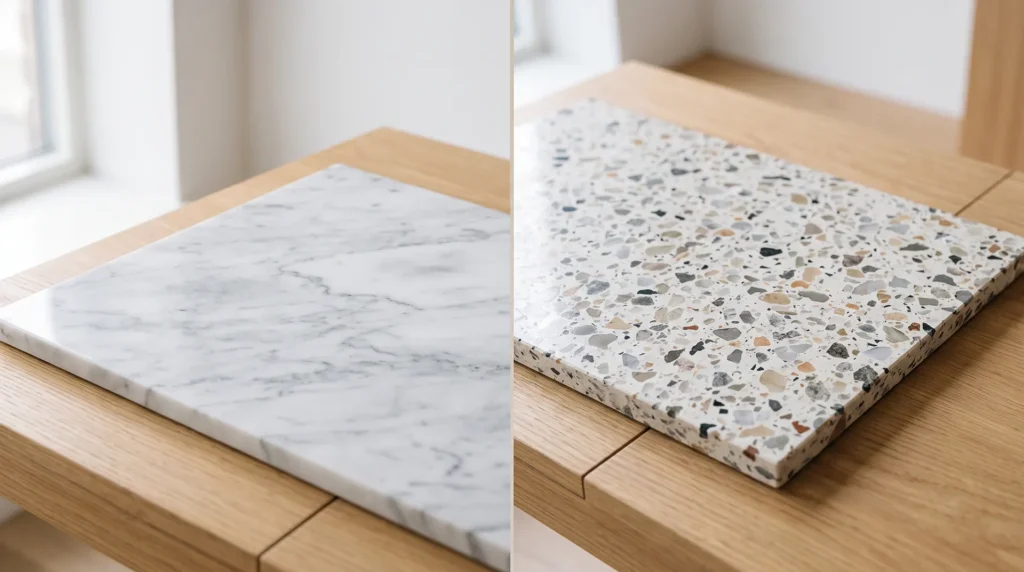
Terrazzo vs. Marble: Which Should You Actually Specify?
Here’s the part most comparisons skip: terrazzo is very often made from crushed marble. So this isn’t quite a contest between two unrelated materials — it’s a comparison between marble in its natural slab form and marble (often mixed with granite, quartz, or glass) suspended in a poured binder. Understanding that relationship is the key to choosing correctly.
Both deliver a high-end look. Both show up constantly in hospitality and residential projects. But they behave completely differently once installed, and the decision usually comes down to traffic, maintenance tolerance, and how much design flexibility the project actually needs.
Quick answer:
Marble is a single, natural stone slab — elegant, classic, but relatively soft and prone to etching and staining without diligent maintenance. Terrazzo is a composite surface made of stone chips (often including marble) set in a cement or epoxy binder, then ground smooth — significantly more durable in high-traffic settings, more customizable in color and pattern, and generally easier to live with day to day. Choose marble for a natural, veined aesthetic and a premium feature surface. Choose terrazzo for floors, commercial spaces, or anywhere durability and design flexibility matter more than natural veining.
What Each Material Actually Is
What Is Marble?
Marble is a natural metamorphic rock formed when limestone is subjected to intense heat and pressure over geologic time, recrystallizing into calcite (CaCO₃). It is quarried in large blocks, cut into slabs, and polished to reveal the veining patterns created by mineral impurities during formation. Every slab is unique. Marble is relatively soft (Mohs 3–4), porous, and reactive to acids — meaning it etches from contact with citrus, wine, or vinegar unless properly sealed and maintained.
What Is Terrazzo?
Terrazzo is a composite flooring and surfacing material dating back to 15th-century Venice, originally created by Venetian workers using leftover marble chips set into clay and polished with stone. Modern terrazzo consists of chips — marble, granite, quartz, or glass — suspended in a binder, either traditional cement or modern epoxy resin, then poured, cured, ground flat, and polished. Because the chip material and binder are both fully controllable, terrazzo can be engineered for color, chip size, chip density, and overall pattern in ways natural marble simply cannot.
- Marble: Natural, quarried, single-material calcite stone — every slab unique, no design control over pattern
- Terrazzo: Engineered composite — chips (often marble) suspended in cement or epoxy — fully controllable color, pattern, and chip density
- Key relationship: Terrazzo frequently contains marble as an ingredient; the comparison is really “whole slab” vs. “engineered composite”
Terrazzo vs. Marble: Side-by-Side Comparison
| Property | Marble | Terrazzo |
|---|---|---|
| Material type | Natural stone slab | Engineered composite (chips + binder) |
| Mohs hardness | 3–4 | Varies — epoxy terrazzo often harder-wearing at the surface |
| Acid/etching resistance | Poor — etches from citrus, wine, vinegar | Good, especially epoxy terrazzo — binder resists etching |
| Pattern/color control | None — natural veining only | Fully customizable chip color, size, and density |
| Seams | Visible slab seams on large areas | Seamless when poured in place |
| Sealing required | Yes — every 1–2 years | Cement terrazzo: yes, periodically. Epoxy terrazzo: minimal |
| Best format | Slabs — countertops, walls, feature surfaces | Poured in place — large floors, seamless runs |
| Typical price range | $40–$500+/sqft installed (grade-dependent) | $25–$60/sqft installed (poured-in-place, standard grade) |
Durability and Maintenance: Where Terrazzo Pulls Ahead
This is the category where the two materials diverge most sharply. Marble’s calcite composition makes it inherently vulnerable to acid etching — a splash of lemon juice or wine left too long will dull the polish permanently, and no amount of sealing fully eliminates this risk, only slows it. Marble also requires re-sealing on a regular schedule to maintain stain resistance.
Terrazzo, particularly modern epoxy terrazzo, is a fundamentally more forgiving surface. The epoxy binder is far less reactive to acids and far less porous than natural marble, which means everyday spills that would etch a marble countertop typically leave epoxy terrazzo unaffected. This is precisely why terrazzo dominates commercial, hospitality, and high-traffic residential flooring — airports, hotel lobbies, and restaurant floors are terrazzo for a reason: it holds up to relentless foot traffic and spills with minimal maintenance.
A labeling caution: Porcelain and vinyl tiles are frequently printed with a “terrazzo look” pattern and marketed loosely as terrazzo. These are not composite stone surfaces at all — they are printed or textured imitations. If durability and authenticity matter, confirm whether you are being quoted actual poured terrazzo (cement or epoxy) or a terrazzo-pattern tile.
Where to Use Each: Application Guide
Flooring
Terrazzo is the clear choice for large-scale flooring, particularly in high-traffic or commercial settings. Its seamless, poured-in-place nature avoids the grout lines of tile and the seams of large marble installations, while offering far better long-term durability underfoot. Marble flooring exists and looks stunning, but requires more careful maintenance and is more vulnerable to etching from tracked-in grit and acidic spills over time.
Kitchen Countertops
Marble remains the more traditional choice here, prized for its natural veining and the way it photographs. Terrazzo countertops are a growing trend, particularly in kitchens seeking a more casual, customizable, or budget-conscious alternative to natural stone — and they hold up notably better to acidic spills, an important consideration on a surface used daily for food prep.
Bathroom Floors and Walls
Terrazzo’s water resistance and slip-resistant finish options make it a strong performer in bathrooms, particularly in commercial or multi-family settings. Marble delivers a more luxurious, natural aesthetic for a primary bath or spa-style space, provided the maintenance commitment is understood upfront.
Feature Walls and Accent Surfaces
This is marble’s strongest category. Natural veining — especially bookmatched across two slabs — is something terrazzo’s more uniform chip distribution cannot replicate. For a genuine feature wall meant to showcase natural stone character, marble remains the better choice. Preview bookmatched veining options with Stone Moods’ Bookmatch Visualizer.
Cost Comparison
Pricing depends heavily on grade and installation method for both materials:
- Marble (standard commercial grade): $40–$100/sqft installed
- Marble (premium, e.g. Calacatta, Statuario): $150–$500+/sqft installed
- Terrazzo (precast tile, standard): $20–$40/sqft installed
- Terrazzo (poured-in-place, epoxy, standard): $25–$45/sqft installed
- Terrazzo (poured-in-place, custom color/pattern): $45–$60+/sqft installed
For large-scale flooring projects, terrazzo typically comes out meaningfully cheaper than natural marble at comparable visual quality, particularly once marble’s ongoing sealing and maintenance costs are factored into the total lifecycle cost.
Compare exact project costs, including maintenance over time, with the Stone Moods True Cost Calculator.
Frequently Asked Questions
Is terrazzo made of real marble?
Often, yes — terrazzo chips are commonly sourced from marble, along with granite, quartz, or glass, depending on the desired look. So terrazzo isn’t a substitute for marble as much as a different way of using it: as engineered chips in a binder rather than as a single natural slab.
Which is more durable, terrazzo or marble?
Terrazzo, particularly epoxy terrazzo, generally outperforms marble in durability, especially resistance to acid etching and high-traffic wear. Marble’s calcite composition makes it inherently more vulnerable to everyday kitchen acids and requires more diligent, ongoing maintenance to preserve its finish.
Is terrazzo cheaper than marble?
Generally, yes, particularly for large-scale flooring. Standard poured terrazzo typically runs $25–$60/sqft installed, while marble ranges from $40/sqft for commercial grade up to $500+/sqft for premium varieties like Calacatta or Statuario. Terrazzo’s lower long-term maintenance costs widen this gap over the life of the installation.
Can you get real marble veining in terrazzo?
No — terrazzo’s chip-and-binder construction produces a speckled, granular pattern rather than the flowing veins characteristic of natural marble slabs. If the design intent specifically calls for dramatic natural veining as a visual feature, marble slab is the only material that delivers it; terrazzo is a different aesthetic category entirely.
Choosing Between Terrazzo and Marble for Your Project?
Compare real installed and lifecycle costs, and preview how marble veining will look before you commit.
Related Reading on Stone Moods
- Calacatta vs. Carrara Marble: The Definitive Comparison
- Statuario vs. Calacatta: The Two Most Prestigious White Marbles Compared
- Marble vs. Porcelain: Which Is Right for Your Project?
- Stone Specification Library