
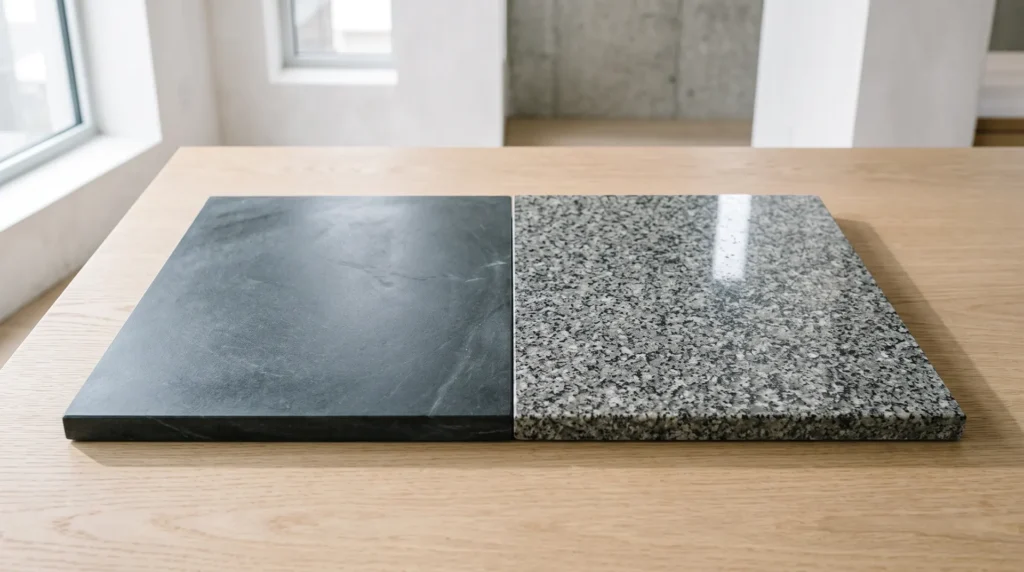
Soapstone vs. Granite: The Soft Stone vs. The Hard Stone
These two sit at almost opposite ends of the hardness scale, and yet both are considered among the most forgiving, kitchen-friendly natural stones available — for completely different reasons. Granite survives daily abuse because it’s hard. Soapstone survives daily abuse because it doesn’t care — it’s chemically inert, and the scratches it does pick up are part of the material’s character, not a flaw to fight.
If your mental model of “durable stone” is built entirely around hardness, this comparison is worth reading closely, because soapstone breaks that model in an interesting way.
Quick answer:
Granite is a hard igneous rock (Mohs 6–7) that resists scratching and etching through sheer density, offers an enormous range of natural colors, and requires periodic sealing since it is porous. Soapstone is a soft metamorphic rock (Mohs 1–2) composed primarily of talc — it scratches and dents easily, but it is completely non-porous and chemically inert, meaning it never needs sealing and is entirely unaffected by acids, wine, or bleach. Choose granite for color variety and scratch resistance. Choose soapstone if you want zero acid anxiety, a naturally antibacterial surface, and don’t mind a material that visibly ages with use.
Geology: An Igneous Rock vs. a Talc-Based Metamorphic Rock
What Is Granite?
Granite is an igneous rock formed from magma that cools slowly deep underground, allowing large, visible mineral crystals to develop. It’s composed primarily of quartz, feldspar, and mica, and the ratio of these minerals determines its color — which is why granite spans an unusually wide palette, from near-black to white, gold, blue, and red. Its crystalline structure gives it a granular, speckled look and genuine hardness.
What Is Soapstone?
Soapstone (also called steatite) is a metamorphic rock composed primarily of talc, along with varying amounts of chlorite, magnesite, and mica. Talc is the softest mineral on the entire Mohs hardness scale (rated 1), which is why soapstone is famously soft to the touch — early carvers could shape it with hand tools, and its name comes from its soapy, smooth feel. Countertop-grade soapstone typically has a higher talc-to-mineral ratio balance than sculptural grades, giving it slightly more structural integrity, but it remains far softer than any igneous or siliceous stone.
- Granite composition: Quartz, feldspar, mica — igneous, hard, crystalline
- Soapstone composition: Talc-dominant — metamorphic, soft, dense, non-porous
- Key difference: Granite’s durability comes from hardness; soapstone’s comes from chemical inertness despite softness
Soapstone vs. Granite: Side-by-Side Comparison
| Property | Soapstone | Granite |
|---|---|---|
| Rock type | Metamorphic (talc-based) | Igneous |
| Mohs hardness | 1–2 | 6–7 |
| Acid resistance | Excellent — chemically inert | Excellent — non-reactive minerals |
| Scratch resistance | Poor — scratches easily | Excellent |
| Porosity | Non-porous — never needs sealing | Porous — needs periodic sealing |
| Heat resistance | Excellent | Excellent |
| Color range | Narrow — greys, greens, near-black | Very wide — black, white, gold, blue, red |
| Finish behavior | Matte, darkens and develops patina with oiling/use | Can be polished, honed, or leathered; stays consistent |
| Typical price range | $70–$150/sqft installed | $25–$100/sqft installed |
Two Completely Different Paths to “Durable”
It’s worth sitting with why both of these stones are considered durable, because the mechanisms couldn’t be more different. Granite’s durability is mechanical: its hardness physically resists scratching, and its low porosity (especially once sealed) resists staining and etching. It behaves the same way on day one and year twenty.
Soapstone’s durability is chemical, not mechanical. Because it’s composed of talc — a mineral with no reactive chemistry — nothing in a typical kitchen or bathroom will stain, etch, or corrode it. Wine, lemon juice, bleach, and vinegar simply do nothing to soapstone. But its physical softness means it picks up scratches, dents, and knife marks from daily use. Most soapstone owners embrace this rather than fight it: the surface develops a rich, deepening patina over time, especially with regular mineral oil application, and small scratches can often be sanded out entirely — something impossible with granite.
A mindset check: Soapstone is the wrong choice for anyone who wants a surface that looks untouched after ten years. It is the right choice for anyone who actively likes the idea of a surface that visibly lives alongside them. Ask yourself honestly which category you’re in before specifying soapstone — this decision matters more than any technical spec on this page.
Where to Use Each: Application Guide
Kitchen Countertops
Both are excellent, but for different kitchens. Granite suits a busy family kitchen where color choice matters and a pristine, unchanging surface is the priority. Soapstone suits a kitchen — often a farmhouse, traditional, or baking-focused kitchen — where the owner wants zero acid anxiety and doesn’t mind, or actively wants, a surface that ages visibly.
Wood-Burning Stoves and Fireplace Surrounds
Soapstone has a genuine historical edge here: its high heat capacity and even heat retention made it the traditional material of choice for wood stoves and radiant heaters for centuries, and it remains a strong choice for fireplace surrounds today. Granite handles heat well too, but lacks soapstone’s specific heat-retention properties that make it uniquely suited to slow-release warmth applications.
Laboratory and Utility Surfaces
Soapstone’s total chemical inertness has made it a longstanding choice for laboratory workbenches and utility sinks, where resistance to acids and chemical reagents matters more than scratch resistance. Granite is a reasonable substitute in lower-intensity utility settings but doesn’t match soapstone’s specific chemical resistance profile.
Outdoor Kitchens and Patios
Granite is the clear choice outdoors, offering excellent weather and UV resistance across its wide color range. Soapstone is rarely specified outdoors — while it handles moisture and chemicals fine, its softness makes it more vulnerable to impact damage in an exposed setting.
Cost Comparison
- Granite (standard commercial grade): $25–$60/sqft material; $40–$80/sqft installed
- Granite (premium, exotic colors): $60–$100+/sqft material; $80–$100+/sqft installed
- Soapstone (standard grade): $50–$90/sqft material; $70–$110/sqft installed
- Soapstone (premium, dense architectural grade): $90–$150+/sqft material; $110–$150+/sqft installed
Soapstone typically costs more than standard granite, driven by more limited quarrying sources and the more specialized fabrication and installation techniques it requires compared to harder stones.
Run your exact project numbers with the Stone Moods True Cost Calculator.
Frequently Asked Questions
Does soapstone scratch easily?
Yes, significantly more easily than granite. Soapstone’s Mohs hardness of 1–2 means knife marks, impact dents, and surface scratches accumulate with regular use. Many owners consider this part of soapstone’s character rather than a defect, and minor scratches can typically be sanded out. If scratch resistance is a top priority, granite is the better choice.
Does soapstone need to be sealed?
No — this is one of soapstone’s key advantages. It is naturally non-porous, so it never requires sealing against staining. Regular mineral oil application is still recommended, but this is a cosmetic step to deepen and even out the stone’s color, not a protective sealing requirement like granite’s periodic sealing.
Is granite or soapstone better for a kitchen island?
It depends on priorities. Granite offers a far wider color selection and stays visually consistent over decades with minimal effort. Soapstone offers zero acid anxiety and a naturally antibacterial surface, but requires accepting a material that visibly changes and scratches with use. Neither is objectively better — the right choice depends on whether you want a static or an evolving surface.
Can soapstone go outdoors?
Soapstone tolerates moisture and temperature swings well, but its softness makes it more vulnerable to impact damage than granite in an unprotected outdoor setting. Granite’s superior hardness and its extensive track record in outdoor applications make it the more common and generally safer choice for exterior use.
Choosing Between Soapstone and Granite for Your Project?
Compare real installed costs and confirm which stone actually fits how you live before you commit.
True Cost Calculator
Find Your Stone
Maintenance Reality Score
Related Reading on Stone Moods
- Granite vs. Quartzite: Which Hard Stone Wins for Your Kitchen?
- Best Stone for Kitchen Countertops: The Complete Guide
- Dolomite vs. Marble: What’s the Difference and Which Should You Choose?
- Stone Specification Library