
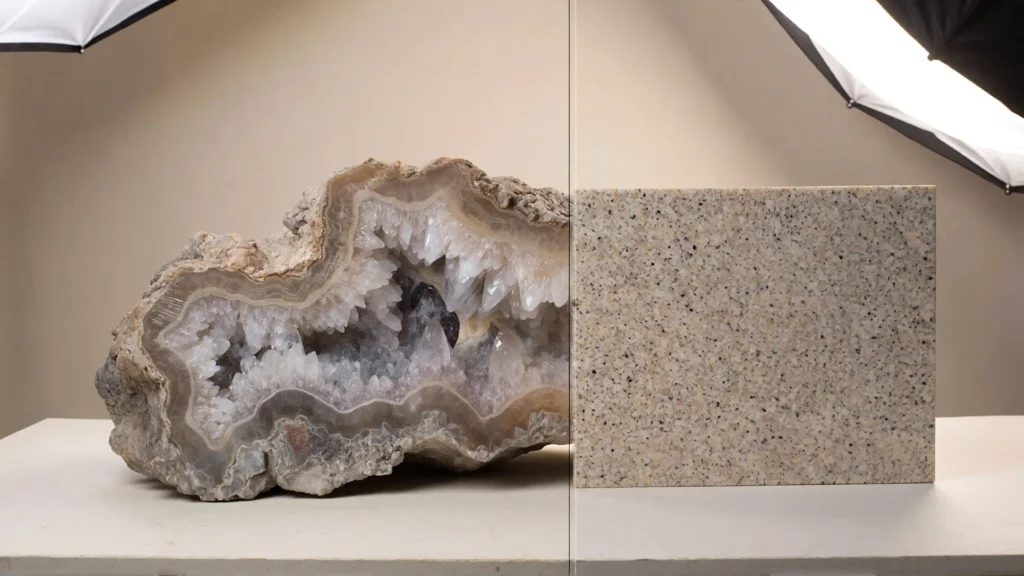
Quartz vs. Quartzite: The Battle of Nature vs. Engineering
Introduction: The Name Game “They sound almost identical. They look somewhat similar. But in the world of geology and design, Quartz and Quartzite are as different as a diamond and a cubic zirconia.
One is a man-made product designed for convenience. The other is a geological marvel, forged by intense heat and pressure to become one of the hardest materials on Earth. If you are looking for the ‘indestructible’ kitchen counter, you are asking the right questions. Here is the definitive breakdown.”
1. What is Quartz? (The Bakery Logic)
Let’s be clear: Quartz countertops are engineered. Think of it like baking. Manufacturers take crushed quartz minerals (about 90-93%), mix them with resins (plastic binders) and pigments, and bake them into slabs.
-
The Result: A surface that is non-porous and uniform.
-
The Flaw: Because it contains resin, it has a melting point. It is essentially stone dust held together by high-tech glue.
2. What is Quartzite? (The Geological Miracle)
Quartzite is 100% natural stone. It starts its life as simple sandstone. Over millions of years, tectonic pressure and volcanic heat fuse the sand grains together so tightly that they recrystallize.
-
The Result: A metamorphic rock that is harder than granite, harder than steel, and often harder than glass.
-
The Beauty: It often mimics the look of high-end marble (like the famous Taj Mahal or Perla Venata) but possesses the strength of a warrior.
3. The Showdown: Why Quartzite Wins for Purists
-
Round 1: Heat Resistance
-
Quartz: Fails. A hot pan can scorch the resin, leaving permanent yellow/brown burn marks.
-
Quartzite: Wins. It was born in heat. You can place hot cookware directly on it (though we still suggest caution) without fear of melting.
-
-
Round 2: UV Resistance (Outdoor Use)
-
Quartz: Fails. Direct sunlight will cause the pigments in the resin to fade or yellow over time. It is strictly an indoor material.
-
Quartzite: Wins. It is UV stable. Use it for your outdoor kitchen, pool deck, or facade. It loves the sun.
-
-
Round 3: The “Soul” Factor
-
Quartz: Can look repetitive. The patterns are printed or aggregated.
-
Quartzite: Has “Crystalline Depth.” When you look closely at a slab of Taj Mahal, you see into the stone. The visuals are 3D, complex, and unrepeatable.
-
4. The “Soft Quartzite” Warning (Buyer Beware)
A critical note for our readers: Not all stones labeled “Quartzite” are pure. Some stone yards mislabel hard marbles (like Super White or Dolomite) as Quartzite.
-
The Test: True Quartzite will scratch a glass bottle. If the stone gets scratched by the glass, it’s likely marble. Always ask for a scratch test.
Conclusion: “If you want consistency and zero maintenance, buy Quartz. But if you want a piece of the earth that is tougher than granite and as beautiful as marble, the answer is Quartzite. It is the ultimate investment for the 2026 home.”