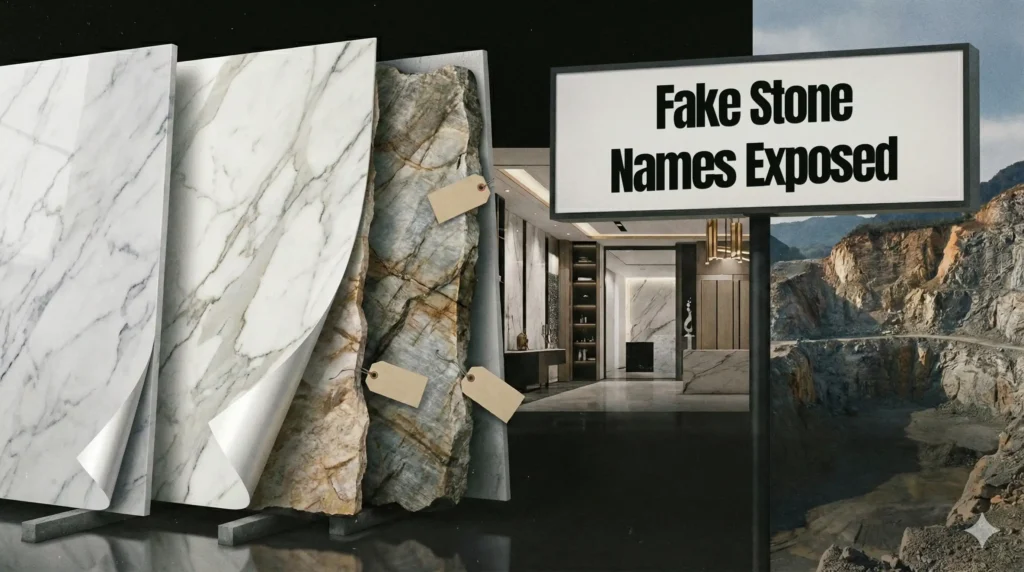
Marketing fantasy versus geological reality
In the natural stone industry, names sell faster than geology.
Terms like “Carrara Look” or “Calacatta Style” create instant familiarity, but often hide the most important truth: stone is not defined by how it looks, but by where it comes from and how it behaves. This report exposes how misleading stone names distort expectations, pricing, and long-term performance — and why quarry origin matters more than branding.
Why Stone Names Are Rarely What They Seem
In the natural stone industry, a name is rarely a definition.
Most stone names are designed to simplify choice, speed up sales, and create instant familiarity — not to describe geological reality.
The same name can be used for stones coming from different quarries, even different countries. While they may look similar in color or veining at first glance, their mineral composition, porosity, density, and long-term behavior can vary dramatically. This is how buyers end up comparing stones that share a label but not a performance profile.
This practice persists because it makes the market easier to navigate — at least on the surface. Marketing names reduce complexity, but they also remove accountability. When a stone is sold by resemblance rather than origin, expectations are shaped by imagery instead of facts. This is the core problem behind fake stone names and other misleading stone names: they trade clarity for convenience, and truth for speed.
Marketing Names vs Quarry Origin
In natural stone, identity is geological, not visual.
Yet most stones are sold by how they resemble something else, not by what they actually are.
A quarry origin is a stone’s real identity. It defines:
-
Mineral composition
-
Density and porosity
-
Structural behavior
-
Weathering and aging pattern
-
Long-term performance
A marketing name, on the other hand, is a comparison.
It suggests familiarity, prestige, or association — but it does not describe geological reality.
Two stones can look nearly identical on a showroom rack and behave completely differently once installed. One may be dense and stable, the other porous and reactive. One may age gracefully, the other stain, crack, or discolor within years. The difference is rarely visible at first glance — but it is always present in the quarry.
This is where expectations collapse.
Buyers think they are choosing a type of stone, when in fact they are choosing a story.
Real stone has a quarry.
Everything else is a comparison.
Understanding quarry origin shifts the decision from aesthetics to performance. It replaces naming myths with material truth — and turns stone selection into an informed choice rather than a gamble.
How Fake Stone Names Inflate Expectations
Stone names do more than identify a material — they frame expectations.
When a stone is marketed with a familiar or prestigious name, buyers subconsciously import everything they associate with that reference: origin, quality, performance, and even cultural value.
This is where disappointment begins. A stone sold under a name that evokes Carrara, Calacatta, or other iconic references may share visual traits, but it rarely shares the same geological behavior. Expectations are set at a level the material was never meant to meet. When staining appears, surfaces etch, or color shifts over time, the issue is not the stone itself — it is the promise attached to its name.
Inflated expectations distort decision-making. Buyers focus on appearance instead of suitability, comparing stones by resemblance rather than application. Over time, this gap between perceived identity and actual performance leads to mistrust, unnecessary maintenance costs, and the false belief that natural stone is inherently unreliable. In reality, the failure lies in the name, not the material.
The Hidden Cost of Naming Tricks
Misleading stone names do not only distort expectations — they create real, measurable costs.
When a material is chosen based on resemblance rather than identity, the consequences surface slowly, often after installation is complete and decisions are irreversible.
A stone selected under a familiar name is frequently specified for applications it was never suited for. Outdoor use, wet areas, high-traffic zones, or chemically exposed environments amplify the mismatch. What follows is not aesthetic disappointment, but technical failure: increased sealing cycles, surface damage, premature wear, and in some cases complete replacement.
These costs rarely appear in the initial quotation. They emerge over time as maintenance budgets expand and corrective work becomes necessary. The irony is that the stone itself is often blamed, reinforcing the myth that natural stone is unpredictable or high-risk. In truth, the risk originates in the naming shortcut — a decision made to simplify the sale rather than respect material reality.
Why This Practice Continues
Misleading stone names persist not because they work well, but because they work quickly.
In a global market driven by speed, familiarity reduces friction. A recognizable name shortens explanations, avoids technical discussions, and accelerates purchasing decisions.
For suppliers, naming by resemblance simplifies inventory and broadens appeal. One name can cover multiple quarries, variations, and qualities, allowing flexibility in sourcing and pricing. For buyers, especially those without deep material knowledge, the name offers comfort — a sense of control in a complex decision.
What sustains this practice is information asymmetry. When geological identity is not clearly documented or demanded, marketing fills the gap. Over time, this normalizes ambiguity and shifts responsibility away from performance and onto perception. The industry adapts to convenience, even when it undermines long-term trust.
How to Identify Real Stone Identity
Identifying real stone identity requires shifting focus from names to documentation.
A genuine natural stone is defined by verifiable information, not by how closely it resembles something else.
The first indicator is quarry origin. Every real stone has a traceable source — a quarry name, a geographic location, and a geological context. This information should be available without hesitation. If a supplier cannot clearly state where a stone comes from, the name alone is meaningless.
The second indicator is a technical data sheet. Properties such as density, porosity, water absorption, and recommended applications reveal how a stone will behave over time. These metrics matter far more than color or veining, especially for outdoor, wet, or high-traffic environments.
Finally, real stone identity is reinforced by application honesty. A trustworthy supplier will explain where a stone performs well — and where it does not. This willingness to limit use is a signal of material knowledge and accountability. When stone is sold with clear origin, documented performance, and realistic application guidance, the name becomes secondary — and the decision becomes informed rather than speculative.
Not All Stone Names Are Misleading
Misleading names dominate the market, but they are not universal.
Some suppliers choose clarity over convenience. They define stone by quarry origin, geological classification, and documented performance, not by resemblance or borrowed prestige.
These suppliers understand that naming is not a marketing shortcut, but a responsibility. They disclose where a stone comes from, explain how it behaves, and avoid selling materials into applications where failure is likely. Their names may be less familiar — but their outcomes are far more predictable.
Transparency does not simplify the sale.
It protects the decision.
Explore Verified Stone Sources
Stone Moods identifies brands and suppliers who operate with:
-
Traceable quarry origins
-
Honest material classification
-
Clear performance documentation
-
Application-driven recommendations
This is not a directory.
It is a filter built to separate material truth from marketing fiction.