
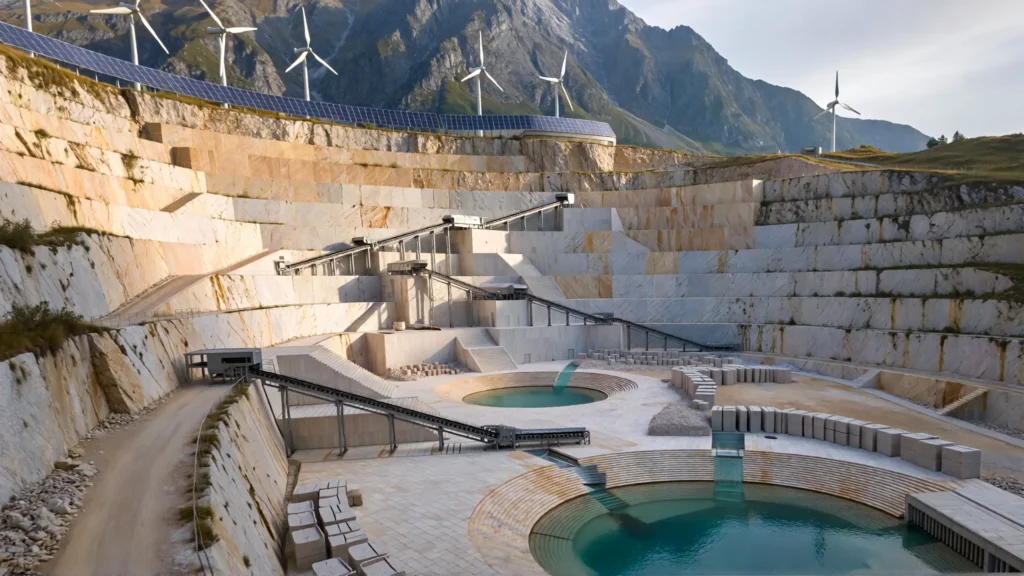
The Zero-Waste Quarry: How Technology is Redefining Sustainable Stone
Introduction: The End of the “Scarred Earth” Era “For decades, the image of a stone quarry was one of extraction and depletion. Huge blocks were cut, and mountains of waste (rubble) were left behind. But in 2026, the narrative has shifted.
Driven by strict environmental regulations and the demands of sustainable architecture (LEED & BREEAM), modern quarries are transforming into high-tech, circular ecosystems. From water recycling to turning stone dust into ceramics, technology is ensuring that not a single pebble is wasted. Here is the industrial revolution happening inside the mountain.”
1. Precision Extraction: The Death of the Explosive
In the past, dynamite was the standard. It was fast but destructive, causing micro-cracks in the stone and resulting in 40% material waste.
-
The Tech: Today, Diamond Wire Saws and Chain Saws slice through mountains with surgical precision.
-
The Impact: This ‘surgical extraction’ reduces waste to nearly zero and preserves the structural integrity of the slab. It means we get more square meters of marble from the same footprint, reducing the environmental impact per slab.
2. Liquid Gold: 98% Water Recycling
Processing stone requires millions of liters of water to cool the blades and suppress dust. Historically, this was a massive drain on local water tables.
-
The Tech: Enter the Filter Press (Lamellar Clarifier). These massive machines capture the ‘sludge’ (muddy water) from the factory, separate the solid particles, and return crystal clear water back to the cutting line.
-
The Impact: Modern factories now operate on a closed-loop system, recycling up to 98% of their water. It is no longer a consumption industry; it is a circulation industry.
3. From Dust to Brick: The “Sludge” Economy
The biggest headache for any quarry is ‘marmettola’—the fine stone dust created during cutting. Until recently, it was landfill waste.
-
The Innovation: New chemical binding technologies allow this calcium-rich dust to be compressed into Eco-Bricks or used as a primary ingredient in high-performance cement and fertilizers.
-
The Result: What used to be a disposal cost is now a secondary revenue stream. The waste of the quarry builds the walls of the city.
4. The Rise of “Off-Cut” Terrazzo
Technology has also influenced aesthetics. Advanced resin-binding machinery allows factories to take the small, unusable chunks of marble (off-cuts) and bind them into large-format Terrazzo blocks.
-
The Design Angle: This isn’t just recycling; it’s upcycling. It creates a completely new, highly durable surface material that celebrates the ‘broken’ pieces of nature.
Conclusion: “True sustainability is not about using synthetic alternatives; it is about respecting the resource we take from the earth. When you specify natural stone today, you are choosing a material that is increasingly extracted with surgical care and a zero-waste mindset. The future of the quarry is clean, precise, and circular.”
Architect’s Note: Looking for LEED points? Ask your supplier for their EPD (Environmental Product Declaration) to verify their water and waste management practices.