
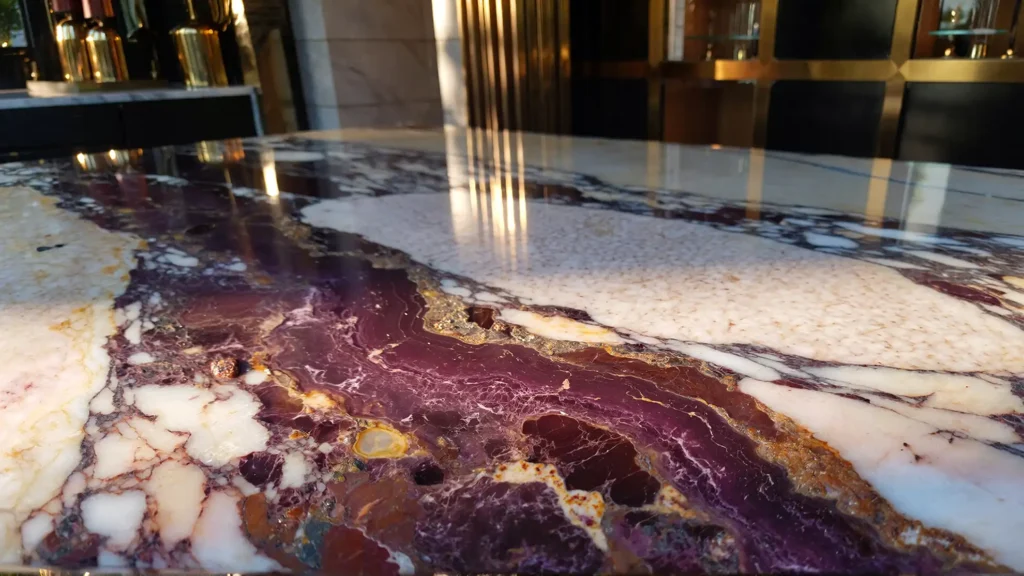
While large-format porcelain dominates the mass market, true high-end design is doubling down on the one thing technology can’t print: Chaos.
Don’t have time to read? Download the Comparison PDF.
The Reality Check Walk into a mid-range kitchen showroom in 2025, and you will see “Marble-look” porcelain everywhere. It is durable, it is stain-resistant, and the printing technology is terrifyingly good. But there is a problem. It is too perfect. At Stone Moods, we analyze the top 1% of residential projects globally, and the verdict is in: The ultra-wealthy are rejecting the “printed look.” Why? Because in a world of AI and mass production, perfection is cheap. Flaws are expensive.
1. The “Repeat” Problem The biggest giveaway of a non-natural surface is the pattern repeat. Even with advanced 50-face printing, the human eye is excellent at spotting artificiality.
-
The Trend: High-end clients are demanding book-matched natural stone walls where the veins align chaotically, telling a geological story that spans millions of years.
-
The Insight: You are not buying a surface; you are buying a piece of time. A printed slab is a product; a natural slab is an asset.
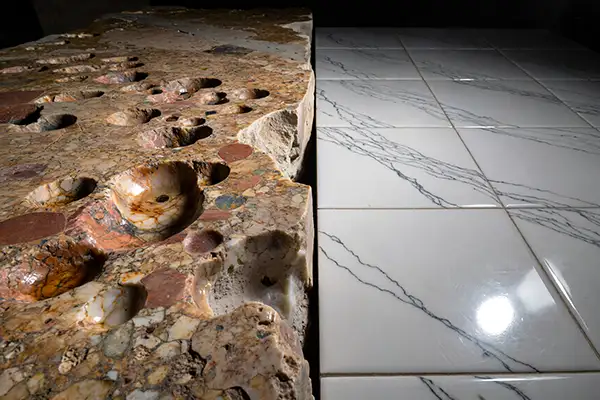
2. Tactical Experience: Cold vs. Soul Run your hand across a printed porcelain slab. It feels like glass—cold, sterile, uniform. Now touch a honed Calacatta Viola or a leather-finished Titanium Granite.
-
The Shift: Designers are prioritizing “haptic feedback” (touch experience). The natural variations in stone density create a tactile map that synthetic materials fail to replicate. Real luxury is felt, not just seen.
3. Patina is a Feature, Not a Bug The marketing machine of artificial stone sells “zero maintenance.” They tell you natural stone scratches and stains. Let’s be honest: It does. But look at the floors of an Italian villa or a French chateau. The wear, the softening of edges, the slight dullness in high-traffic areas—this is called Patina.
-
The Argument: A scratched porcelain tile looks broken and needs replacing. A worn marble counter looks “lived-in” and authentic. We are seeing a return to materials that age with the house, rather than materials that try to freeze time.
4. The Sustainability Paradox Greenwashing is rampant. While ceramics claim to be eco-friendly, the energy consumption required to fire kilns at 1200°C is astronomical. Natural stone requires cutting and finishing, but the material itself is already made by the earth.
-
Future Outlook: As carbon footprint transparency becomes mandatory in construction, low-processing natural stones (local specifically) will gain an edge over energy-intensive manufactured slabs.
Conclusion: The Death of the “Look-Alike” If you want a plastic-wrapped, safe, hotel-lobby look, buy the porcelain. But if you want a home that breathes, changes, and holds value, there is no substitute for the real thing. Stone Moods Verdict: 2025 is the year we stop apologizing for stone’s imperfections and start celebrating them as the ultimate mark of exclusivity.