
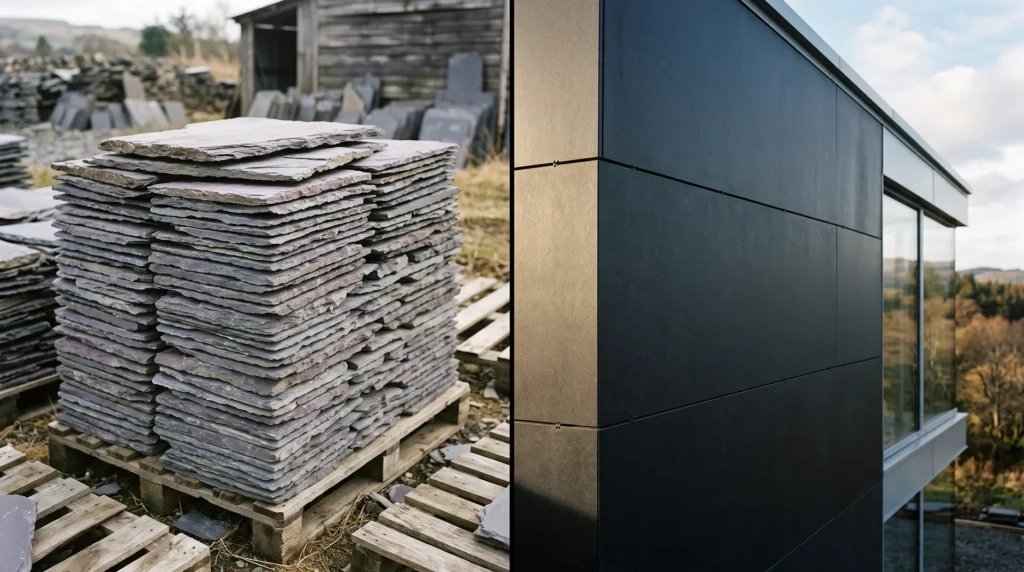
Slate vs. Basalt: Which Dark Stone Wins for Facades and Floors?
Both read as dark, moody, architectural stone — and both show up constantly in the same conversations about facades, roofing, and minimalist exteriors. But geologically, they could hardly be more different. Slate is a layered, sedimentary-derived metamorphic rock that wants to split into thin sheets. Basalt is a massive, structureless igneous rock that has no natural direction at all. That single structural difference is the real reason one ends up on your roof and the other ends up as a thirty-foot seamless facade panel.
This comparison pairs naturally with our look at basalt vs. granite — here the question isn’t hardness, it’s structure: what each stone’s internal geometry actually lets you build with it.
Quick answer:
Slate is a foliated metamorphic rock that splits naturally along flat cleavage planes into thin sheets — a direct result of its sedimentary shale origin — giving it a layered, riven texture and a genuinely wide color range beyond black (grey, green, purple, rust-red). Basalt is a massive, non-foliated igneous rock with no natural cleavage whatsoever, meaning it can be sawn to any thickness or panel size in a uniform, fine-grained charcoal-to-black finish. Choose slate for roofing, riven-texture flooring, and thin cladding tiles where the natural-cleft look and lower cost matter. Choose basalt for large-format monolithic facade panels, paving, and anywhere a completely seamless dark surface is the design goal.
Geology: A Foliated Metamorphic Rock vs. a Massive Igneous Rock
What Is Slate?
Slate forms through low-grade regional metamorphism of shale or mudstone — a fine sedimentary rock made largely of clay minerals — subjected to heat and directional pressure that realigns platy minerals like mica and chlorite into parallel layers. This mineral alignment, called foliation, gives slate its single most defining and useful property: fissility, the ability to split cleanly along flat, parallel planes into thin sheets. Slate’s color range is wider than most people expect — the grey and black most associate with roofing tiles is joined by green (chlorite-rich), purple (hematite-rich), and rust-red (iron oxide) varieties, depending entirely on the parent shale’s original mineral content.
What Is Basalt?
Basalt is an extrusive igneous rock, formed when mafic — iron- and magnesium-rich — lava cools rapidly at or near the earth’s surface. Because cooling happens in minutes to hours rather than over geologic time, no directional pressure or platy mineral alignment ever develops. Basalt is a massive, homogeneous rock with no natural cleavage or foliation in any direction. Every plane cuts and behaves identically, which is exactly why it can be fabricated into any panel thickness or format without regard to a “grain” the way slate must be.
- Slate formation: Metamorphic — foliated shale, splits naturally along cleavage planes
- Basalt formation: Igneous — extrusive, massive, no natural cleavage in any direction
- Key difference: Slate’s usable thinness is a byproduct of geology; basalt’s uniform thickness is purely a matter of fabrication choice
Slate vs. Basalt: Side-by-Side Comparison
| Property | Slate | Basalt |
|---|---|---|
| Rock type | Metamorphic (foliated) | Igneous (extrusive, massive) |
| Mohs hardness | 3–4 | ~6 |
| Natural cleavage | Yes — splits into thin sheets | None |
| Color range | Grey, black, green, purple, rust-red | Narrow — grey to near-black |
| Acid resistance | Good | Excellent |
| Water absorption | Low (roofing grade) to moderate (lower grades) | Low in dense varieties |
| Typical formats | Thin tiles, shingles, flagstone | Large panels, slabs, paving setts |
| Typical price range | $15–$60/sqft installed | $30–$110/sqft installed |
The Real Difference Is Fissility, Not Hardness
It’s tempting to frame this comparison around hardness — basalt at roughly Mohs 6 is nominally tougher than slate’s Mohs 3–4. But hardness rarely decides which of these two stones gets specified. What actually decides it is what each stone’s internal structure lets you physically build.
Slate’s natural cleavage means its riven face — the surface exposed when a sheet is split, not sawn — is often used untouched as the finished surface. This is precisely why traditional slate roofing has survived for over a century in some installations: no machining is required for the main face, only splitting along a plane the stone already wants to follow. The tradeoff is scale — slate’s usable panel size is bounded by how large a sheet can be split without fracturing, which keeps it in the tile, shingle, and flagstone range rather than large continuous panels.
Basalt has no such constraint, but also no such shortcut. Every basalt surface must be fully sawn and machined, since the stone has no natural plane to exploit. What that buys you in exchange is scale: because basalt behaves identically in every direction, it can be cut into large, continuous panels with a genuinely seamless, monolithic appearance — something slate’s inherently layered format cannot replicate at the same size.
A naming caution: “Slate” is one of the most loosely used stone names in the trade. Cheaper metamorphic look-alikes — phyllite, and in some cases low-grade shale — are frequently sold as slate despite meaningfully different freeze-thaw durability, and porcelain or ceramic tile printed with a slate-look pattern is common in flooring aisles. If genuine geological slate matters for exterior or roofing use, where long-term weathering performance is critical, ask for the specific quarry region — Vermont, Welsh, Brazilian, and Spanish slate all have distinct performance profiles — rather than relying on the name alone.
Where to Use Each: Application Guide
Roofing
Slate has essentially no equal here. Its natural riven face, inherent low water absorption, and a genuine multi-generational track record — some slate roofs exceed a century in service — make it the traditional premium roofing material worldwide. Basalt is almost never used for roofing; its total lack of natural cleavage makes producing thin, roofing-scale tiles impractical and far more costly than simply splitting slate along its natural plane.
Building Facades and Cladding
This is basalt’s clear strength. Because it has no grain to fight, fabricators can cut large, continuous panels that read as a single monolithic mass at building scale — an effect we cover in more depth in Minimalist Facades: The Volcanic Authority of Basalt. Slate cladding exists and delivers genuine textured, old-world character, but at a smaller tile-sized module with visible joint lines rather than basalt’s seamless sweep.
Flooring and Patios
Both perform well outdoors and in high-traffic zones. Slate’s natural riven texture provides excellent slip resistance even wet, making it a longstanding favorite for entryways, patios, and pool surrounds. Basalt flooring, typically finished honed or flamed rather than left in a natural cleft state, delivers a more uniform, minimalist look suited to contemporary interiors.
Fireplace Surrounds and Feature Walls
Slate’s layered, textured surface brings genuine old-world warmth to a fireplace surround, particularly in its natural riven finish — a look basalt’s uniform tone doesn’t attempt to replicate. Basalt suits a more minimalist, contemporary fireplace treatment where a single unbroken dark plane is the design goal.
Cost Comparison
- Slate (standard, domestic or imported, roofing/flooring grade): $8–$20/sqft material; $15–$35/sqft installed
- Slate (premium, e.g. Vermont or Welsh, select grade): $20–$45/sqft material; $35–$60+/sqft installed
- Basalt (standard, regionally sourced): $25–$50/sqft material; $30–$70/sqft installed
- Basalt (premium, imported or rare finish): $50–$90+/sqft material; $70–$110+/sqft installed
Slate generally comes in at a lower cost than basalt across comparable grades, particularly for roofing and standard flooring applications — though premium quarry-specific slate can approach basalt’s price range once selective grading and import costs are factored in.
Run your exact project numbers with the Stone Moods True Cost Calculator.
Frequently Asked Questions
Is slate harder than basalt?
No. Slate typically registers Mohs 3–4, while basalt sits around Mohs 6. In practice this difference matters less than it sounds — slate’s real-world durability, especially in roofing, comes from its low water absorption and weathering resistance rather than raw hardness.
Can basalt be used for roofing?
Rarely, and not practically. Basalt’s lack of natural cleavage means producing thin, roofing-scale tiles requires extensive sawing rather than simple splitting, making it far more expensive and less proven for this use than slate, which has centuries of roofing history behind it.
Why does slate split into flat sheets and basalt doesn’t?
Slate forms through metamorphism of shale under directional pressure, which aligns platy minerals like mica into parallel layers — a structure called foliation. Basalt forms from rapidly cooling lava with no directional pressure involved, so it never develops that layered alignment and remains a massive, structureless rock in every direction.
Which is better for a modern facade, slate or basalt?
Basalt is generally the stronger choice when the design goal is a large, seamless, monolithic surface, since its lack of grain allows big continuous panels. Slate remains a strong choice for facades where a textured, old-world, tile-scale module is the intended look rather than a single unbroken plane.
Choosing Between Slate and Basalt for Your Project?
Compare real installed costs and confirm what you’re actually sourcing before you commit.
Related Reading on Stone Moods
- Basalt vs. Granite: Two Hard Stones, Two Different Origins
- Minimalist Facades: The Volcanic Authority of Basalt
- Granite vs. Quartzite: Which Hard Stone Wins for Your Kitchen?
- Stone Specification Library